Friday, January 11, 2013

Sally's Place: A Special Music Store


Sally's Place, on the 2nd floor at 190 Main Street.
picture courtesy of Dan Woog
 
I've wanted to write about my local record shop, Sally's Place (190 Main Street, Westport CT 06880 203-454-0303) since I began this blog but could never write a piece that I was happy enough with, one that provided the proper understanding of just how special the place really is in this age of the internet and on-line music. How to let people know about the amazing collection inside, not only of jazz but of opera, classical, show music, rock, folk, zydeco, and on and on. But it is the jazz collection that stands out, because first and foremost Sally is a jazz fan. She comes by that naturally, as a classmate in high school of Horace Silver, as a friend of label and club owners and frequenter of the jazz clubs in New York City, just a train ride away, and from being there to close down Bradley's in the wee hours. She has stories galore about the shows, the people, and the clubs, and counts among her friends some of the major names in the arts who made Westport an the surrounding towns their home -- Paul Newman and Joanne Woodward have a prominent place on her walls and in her heart, but also Dave Brubeck, Alan Arkin, John Scofiled, Adam Nussbaum, Benny Wallace and so many others. She has fans all over  the country who once lived here and still keep in touch and call for music they know only she can find, and  musicians who found a place to hear music growing up and are now prominent players. When you've been on Main Street for over 50 years and in your own store over 25 selling music and doing what you love best, life is like that.

I was so pleased today to read in one of the local blogs about Sally (http://06880danwoog.com/2013/01/11/sally-white-the-original-shazam-photos-needed/) , and even more pleased to find a short film about her that captures her essence and the essence of the store by Claire Bangser, one of her many loyal customers and evidently an aspiring film-maker.  Sally doesn't like publicity much, and hates having her picture taken, so this tribute is extra special and is a wonderful insight into "Sally's Place," which I hope you all get to visit sometime. I am glad I waited to post -- I could never have done her justice like Claire does.

Enjoy the film -- here is the link, which is also in Dan Woog's blogpost: http://vimeo.com/56950729

Sally's Place is a home to music-lovers and a community for us. I wish everyone could have a place like this and a Sally White.

Wednesday, January 9, 2013

One Time Only

As I read and explore the world of jazz,  checking out the biographies of the musicians using books and magazines on jazz, summaries in allmusic.com, and blogs I find all sorts of interesting tidbits. One of the most fascinating things is finding those musicians who made only one recording as a leader, and particularly those whose single recording was highly praised, either at the time or now by jazz critics and historians. These are the "Moonlight" Graham's of the jazz world.

The whys and wherefores about these recordings can be a matter of time and place; comfort being a sideman versus a leader; and sadly drugs, sudden illness and death. This post describes the works of eight such musicians, most of whom were active in the 50s and 60s, but sadly includes a recent and painful loss to the New York jazz community in particular.

These are the eight, along with their one release. Note that there are now multiple releases in some case for these players, compilations of their music from other bands, other takes, et al on labels like Fresh Sounds. But below are the eight CDs that are generally recognized as their only recordings as leader, along with some brief words about each.  
  • Product DetailsKenny Kirkland "Kenny Kirkland" (GRP Records 1991) Kirkland was a lauded pianist closely associated with the Marsalis clan who died suddenly at age 43 in 1998. He began his piano studies at age 6, studied at the Manhattan School of Music, and by age 20 was performing with players such as Miroslav Vitous and Elvin Jones. By 1981 he was in Wynton Marsalis' band, with whom he played until he left to back Sting. Later he was in Branford Marsalis' Tonight show band, and in 1991 recorded this sole leader session, which is a creative demonstration of his varied skills with jazz music as he covered songs by Ornette Coleman, a latin bop version of Bud Powell's "Celia", some New Orleans strut, and Monk's "Criss Cross." The power and creativity of  Kirkland is unmistakable and why he never lead another session in his remaining seven years is a mystery.  Great music.  
  • Product DetailsWilbur Ware "The Chicago Sound" (Riverside 1957) Bassist Wilbur Ware's sole recording as leader features an all-star cast of Chicago musicians -- John Jenkins on alto, Johnny Griffin on tenor, Junior Mance on piano, and Wilbur Campbell or Frank Dunlop on drums. How can it be anything but great with those musicians, and in fact it is a terrific hard bop session with some originals by Ware and Jenkins and some standards like "Body and Soul" and "The Man I Love." At the time Ware was just 34 and coming into his own, and while he went on to record as a sideman to the greats, and can be heard on many five-star recordings, he never lead a session again. He passed away in 1979. Recommended listen.
  • Product DetailsDick Twardzik "Trio" (Pacific Records 1955) Richard Twardzik was a creative be-bop pianist from Boston, born in 1931, who made his professional debut in 1945 at age 14. His piano teacher Margaret Chaloff was well-known in Boston and provided him a broad training in classical music as well as jazz. She was baritone sax Serge Chaloff's mother and Twardzik worked in Chaloff's band as well as one led by Charlie Mariano. Unfortunately Twardzik became addicted to heroin as a teenager, and died of an overdose while in Europe with Chet Baker's band in 1931. His is one of the cautionary tales of the jazz world,  a classically trained child prodigy dead at 24 who never saw his one release as leader and never fufilled the promise that everyone in the jazz world saw coming for him. Because Pacific Records only had 22 minutes of his music his leadership date is packaged with trio songs by pianist Russ Freeman to fill up the LP. Here are some of the quotes about Twardzik:
      • "There was this white cat," Cecil Taylor later recalled, "Dick Twardzik . . . He had destroyed some Kenton people by playing like Bud Powell first and getting them all excited and then going into his, at that time, Schoenbergian bag."
      • Steve Kuhn, another student of Madame Chaloff's and a keyboard prodigy, commented: "I admired Twardzik very much, particularly harmonically. He listened to all the modern European composers and was quite advanced."
      • From Ira Gitler: "Twardzik at this stage was not only absorbing the vocabulary of modern jazz, but also soaking up the sounds of contemporary classical music. Just as Brubeck, around this same time, had found a way of marrying his jazz inclinations with the sound universe he learned through his studies with Darius Milhaud, Twardzik was finding a similar source of inspiration in the music of Stravinsky, Hindemith, Bartók and other leaders of the new thing in classical music. As Twardzik brought these elements into his combo work, he created a provocative hybrid, much more than mere imitation, but rather a fresh trail blazed in the annals of American music." 

  • Product DetailsShimrit Shoshan "Keep It Movin'" (Self-Released, CD Baby 2010) I never met Shimrit Shoshan, who died suddenly and tragically this past August from cardiac arrest, at the age of 29. I did know some of the people in New York who knew her and her music well, and the shock in the community was incredibly deep and heart-wrenching; and the expressions of love for her in blog posts, at her memorial at Smalls, and in the newspapers were extremely moving. I also knew her music well, having seen her once in performance and having had her CD since it was released in 2010. "Keep It Movin’" featured a first rate group including Eric McPherson, Abraham Burton, John Hébert and Luques Curtis playing 8 compositions written by Shoshan herself, and those in the community who knew her said it was the first step in what was going to be a fabulous career. I love the CD.  
  • Product DetailsLes Spann "Gemini"(Jazzland 1961) This one comes courtesy of Marc Myers' Jazz Wax blog. Spann made 78 appearances on recordings from 1957 -67 but only one time recorded as a leader. Spann actually played two instruments, guitar and flute, and is pictured on his album with both. Joining Spann on two Gemini sessions were Julius Watkins (French horn), Tommy Flanagan (piano), Sam Jones (bass) and Albert "Tootie" Heath and Louis Hayes (drums). According to the post, and to Orrin Keepnews, Spann' personality was such that he was more comfortable as a session player or member of a band, and didn't push himself for a leadership role, and made a good living as such. Spann played in Quincy Jones' big band, on Red Garland's Solar, and appeared in Charles Mingus' Town Hall concert orchestra in 1962. His record dates included sessions with Duke Pearson in 1965, and Sonny Stitt and Eddie "Lockjaw" Davis in 1966, and his last known recording with Johnny Hodges in 1967. This is one CD I don't have -- I am not a big jazz guitar person.
  • Product DetailsCurtis Amy and Dupree Bolton "Katanga!" (Pacific Jazz 1962) This is about Dupree Bolton, the incredibly talent, troubled, and elusive trumpeter of the early 1960s. In 2009 Ted Gioia published the very interesting and sad story of the mysterious and elusive Dupree Bolton on the website jazz.com, a fascinating tale of a talented but troubled trumpet player, and a much fuller and richer account than I have here. The posts are still on line although the blog is not, and a google search of Bolton's  name will bring you a really fascinating tale. Dupree Bolton was born in 1925 in Oklahoma and about the only thing people know is that he ran away from home at age 14. In 1944, he was in New York playing trumpet in Buddy Johnson’s band, and later with the Benny Carter big band. In 1946 he disappeared, either through illness or imprisonment due to his drug addiction. Then in 1959 he reappeared and played an inventive and explosive trumpet on Harold Land’s "The Fox".  Drugs caught up with him again and it was not until 1962 thaat he co-led this session with Curtis Amy, again showing off his individualistic and inventive soloing. His play captured the imagination of the jazz world, but once again he disappeared into the prison system, this time only reappearing once for a session with Bobby Hutcherson in 1967. After that his path was unknown, excepting a stetch in  the Joseph Harp Correctional Center in Tulsa, Oklahoma where he played in a prison band. Released in 1982, he worked fleetingly with Dexter Gordon in Oklahoma City but thereafter Bolton drifted from sight. Gioia picks up the story in his post, finding him on the streets  in Oakland CA in 1989. He died in 1993 of cardiac arrest. There have been some releases of his music since, and there is also a recording of his prison band available, but "The Fox" and "Katanga" are his real legacy. An amazing story, and some fine trumpet play from a lost and troubled soul.
  • Product DetailsDon Sleet "All Members"(Jazzland 1961)  Don Sleet was a very talented hard bop trumpeter with a beautifully smooth and mellow tone, whose main influences were Kenny Dorham and the early Miles Davis.  Sleet was born in Fort Wayne, IN in 1938 but grew up in San Diego, where he studied both jazz and classical music as a teenager. He played for three years with San Diego Symphony although jazz was his first love. In L.A. he studied with trumpeter Shorty Rogers and by 1960 was with Howard Rumsey's Lighthouse All-Stars. His sole recording as a leader was made at age 22 and was produced by Orrin Keepnews. His supporting cast of all-stars included Jimmy Heath on tenor saxophone, Wynton Kelly on piano, Ron Carter on upright bass, and Jimmy Cobb on drums. Its a great date but for whatever reason never caught on despite the cast. He never recorded a second album, and in 1986 he died of cancer at age 47. Another great CD to listen to if you like the music of the period.
  • Product DetailsJohn Dennis "New Piano Expressions" (Debut 1955) Dennis was an adventurous stylist from Philadelphia in the mid-'50s who recorded just once, for the Mingus/Roach label Debut Records when he was 25 year of age. The album title, the label's producers Mingus and Roach, and the supporting cast of Mingus and Roach clearly state the obvious: Dennis had loads of talent, an adventerous and creative mind, and a magician's touch.  In a 1990 article by Gene Santoro, Jimmy Heath recalled that pianist John Dennis was nicknamed “Fat Genius” by Philadelphia musicians and Muhal Richard Abrams praised Dennis’s “full pianistic approach,” which "blended a cocktail style with jazz and classical strains".  His only other major release was as a sideman on "The Fabulous Thad Jones". "New Expressions" four solo tracks show off Dennis' effortess, balanced two-handed approach, along with his wonderfully lyrical and creative play. There is an oral interview with Walt Dickerson about Dennis, in which he says the following: "There was a pianist, a genius whose name was John Dennis, who had photographic memory, we were like inseparable brothers, we always shared notes... Everyone that came through Philly, they were fearful of him, he was just that awesome... he wasn’t thrilled with the scene at all, because he knew artistically he was far in advance of that which was going on...His record was on the Debut label that Max and Mingus ran. When they heard John, they had to record with him... [His parents were fundementalists who put a lot of pressure on him not to play the devil's music]...it has a physical effect when an artist cannot continue to search and develop his artistry, something happens to that person both physically and mentally...I learned that many people die from a broken heart, nothing wrong with them physically, they're broken-hearted and just give up...and that's what happened to John..." Dennis died in 1963 at age 33.


  • Some mystery, some tragedy, and some really beautiful music.
    .

    Tuesday, January 8, 2013

    Time to Hear: The Christoph Spendel Trio: "Harlem Nocturne"


    Harlem Nocturne album cover
    Christoph Spendel is one of those European gems who has been recording music for over two decades in his native Germany but has zero visibility in the United States, despite a long record of accomplishments with some very high profile American jazz icons. Only with his latest, "Harlem Nocture" (Blue Flame 2012) has he come to my attention.  This is a wonderful, straight-ahead recording full of great trio play with Claudio Zanghieri on bass and Kurt Billker on drums and percussion. 

    Some background on Spendel from his website. Spendel is a German jazz pianist, keyboardist, bandleader, composer, arranger, producer, music professor and music journalist with a thirty year career in the different styles of jazz, rock, latin, classical and modern ambience music.
    He received his first lessons at the age of five from his mother, a music teacher and pianist. His professional career began in 1975 and recording career with a solo recording in 1977, and early on he worked with many major German, European, and American musicians including Albert Mangelsdorff, Christof Lauer, Lee Ritenour, Airto Moreira, Miroslav Vitous and Eddie Harris. In the nineties he spent five years in New York, was a member of the Fusion Band "Special EFX", and performed at the Blue Note as well as across the U.S.  Spendel went on to work with such players as Dave Liebman, Chick Corea, Herbie Hancock, Bob Mintzer, Randy Brecker, Michael Urbaniak, Jeremy Steig,  Jay Anderson, Adam Nussbaum, Lenny White, Steve Kahn and Dave Valentin, to mention only a few. The rhythm section of "Weather Report" played with Spendel on his CD “New York Groove: Cool Street” (TCB 1993). Spendel has taught at conservatories in Cologne, Duesseldorf and Bremen; held a  professorship at the School of Music in Frankfurt; and taught at the Rimon School in Tel Aviv, and the New School for Jazz and Contemporary Music in New York. 

    Returning to my take on  "Harlem Nocturne," Spendel's piano play is evocative and flows beautifully through ballads, upbeat latinate tunes, and moderately swinging melodies most of which were his compositions. The music seems to be based on his impressions of New York and the great tradition of jazz there, with great melodies and great trio-play bringing the best out in each song. Billker provides a range of textures, light cymbal taps and brushes on softer tunes, and driving percussion on the latin songs like "Teguese." He drives this particular song along with his percussion, giving it the latin flavor while Spendel plays a marvelously flowing melody above. Bassist Zanghieri doesn't step out much but is omnipresent setting a floor/frame for each tune. His support is very clear on "Luca by Sunlight" where it appears he switches to an electric bass or if not he gets a huge tone from his instrument. This is a nice mid-tempo song, lightly played on piano with a great deal of movement expressed by the bass and drums. The short and quiet song "Moon Over Lanzaro", which is only just over a minute, is caressed by the touch and rubato play of Spendel, and leads to a lovely, flowing rendition of "Beyond the Sea" by the trio that hearkens back to the versions sung by Bobby Darin and Frank Sinatra. "Happy Kids" is a light mid-tempo bounce that reflects its title, and Spendel's light touch and lightening runs are part of a wonderfully written melody. Zanghieri gets a chance to solo during the song and shines. Finally "The Song is You" is simply exquisite, expressive, and beautifully balanced by the trio.

    This is truly a special CD for those who like mainstream music with an appealing bounce, marvelous dynamics, and flowing melodies. Spendel's tunes and interpretations are marvellous and maintain interest with their range of rhythms and flowing lines. I highly recommend this CD, due out in February.

     1991, with Jay Anderson and Adam Nussbaum (check out the hair!)

    Monday, January 7, 2013

    The 2012 Consensus Top 10, and the CDs I'd Like to Like........

    Everyone says they hate making top ten lists, but everyone does it. I am among those who think it is hard to select a top ten because there is so much good music (and in fact I ended up with a top 13 list plus a supplemental list), but also sees the value in these lists as directional signals to readers. Any single list of course is not an infallible guide, as each is clearly the subjective viewpoint of one individual, but if one knows the critic/reviewer then that list has value to the reader. On the other hand, when the lists are collated and the results summed, the collective wisdom of the jazz writing public is certainly strengthened, and through the collective wisdom of the community a consensus emerges about the best of 2012.


    Product DetailsThe consensus list, the "7th Annual Jazz Critics Poll:2012" is an undertaking of Francis Davis, and currently appears on Rhapsody. It is also summarized on this link:
    http://hullworks.net/jazzpoll/12/index.php.


    One hundred nineteen (119) critics answered the call, and each of their ballots is on the website. But more importantly, the site shows the consensus top ten for new releases (as well as reissues, debuts, lating, and vocals). The top ten and the number of ballots that listed each recording follows:
    1. Vijay Iyer, Accelerando (ACT)   (47)
    2. Sam Rivers-Dave Holland-Barry Altschul, Reunion: Live in New York (Pi)   (44)
    3. Wadada Leo Smith, Ten Freedom Summers (Cuneiform)  (37)
    4. Ryan Truesdell, Centennial: Newly Discovered Works of Gil Evans (ArtistShare) (23)
    5. Ravi Coltrane, Spirit Fiction (Blue Note)  (26)
    6. Henry Threadgill, Tomorrow and Sunny/The Revelry, Spp (Pi)  (23)
    7. Branford Marsalis, Four MFs Playin' Tunes (Marsalis Music)  (20)
    8. Tim Berne, Snakeoil (ECM) (17)
    9. Steve Lehman, Dialect Fluorescent (Pi) (14)
    10. Billy Hart, All Our Reasons (ECM)  (17)

    So what does this tell me? There is no such thing as consensus. Even the top CD appeared on only 47/119 lists (39%), and the tenth on the list appeared on only 17 (14%). In all over 400 CDs appeared at least once!  But it also tells me that there were at least a few CDs that impressed a lot of reviewers, and that free jazz is highly respected.

    I have five of the top ten CDs (1,4,5,7,and 10) and am enjoying each and every one of them. I put two on my top CDs list -- Branford Marsalis and Vijay Iyer -- though none in my top ten. I did better with the next ten (11-20) -- there I have 8 of the ten and 5 among my overall recommended CDs.

    Product DetailsWhat is also clear is that the critics are more adventerous than I am, and far more appreciative of the abstract and free jazz recordings. Of the five in the top ten I have, none are free jazz or even abstract jazz. Of those five, I would say that only Tim Berne's "Snakeoil" is within my range; I have listened to it, like many parts of it, but overall it just is a bit outside of my wheelhouse.

    As for the others, they represent the fullest blossom the the free jazz movement and frankly I just don't understand or appreciate the sounds. But I wish I could. Sometimes I know why I don't like things: wrong instrumentation for me, squeals and skronks, meandering lines, or terrible dissonance. But none of that really seems to be the issue with some these sets.

    I have played samples of the Sam Rivers disc and of the Steve Lehman disc and cannot wrap my head around them. I really want to know what it is I should be listening to, what the musicians are trying to say to me, and what the critics are hearing. When I read the reviews its clear to me I am not hearing the same things, or appreciating them. Expression is fine, but what are the musicians saying? Is is about sound and its production? about poly-rhythms and tempo? micro tones and dissonance? creating soothing atmospheres or friction? tonal quality and getting new sounds from the instruments? I just cannot latch onto it. When two reviewers I appreciate and feel comfort with, Nate Chinen and Peter Hum, put Tim Berne at the top of lists I want to understand why -- maybe I will never fully appreciate the work but at least I want to understand it.

    Alas, I may be doomed. But  I will not be one to say the avant-garde and free jazz is horrible, that the musicians don't know what they are doing, etc. In 2013 I am going to try to latch onto three CDs -- maybe never love them but at least feel them:   
    • Product DetailsSam Rivers/Dave Holland/Barry Altschul "Reunion:Live in New York" (Pi 2012)
    • Wadada Leo Smith "Ten Freedom Summers" (Cuneiform 2012)
    • Steve Lehman Trio "Dialectic Fluorescent" (Pi 2012)
    Why all this angst? What brought this on? I read a couple of posts recently where others wrestled in a small way with some of these issues, and in particular one post that discussed Michael Formanek. In that post, on the site "The Bird is the Worm", the writer indicated that he had not liked Formanek's last recording "The Rub and the Small Change" (ECM 2010) but did like the new one, "Small Places" (ECM 2012)  I too did not like the first of the two CDs, but had just been told I might like the second by somebody I trust who more or less knows my inclinations.

    Product Details
    With those two people in mind, I bought "Small Places" and have listened to it a few times now.  I find it much more interesting and enjoyable, with reservations, than the previous outing. But does it fall into my comfort zone? Here are my track by track impressions which are a bit in a stream of conciousness mode as I wrote them as I listened.

    "Small Places" starts the CD with a very nice piece that begins with some unison sax and piano, and then a very strongly played piano solo. The entire piece has a particularly moody undertone I liked, and overall it felt well organized and held together well for me.

    "Pong" gets off to a nice start as well with another mellow tune, some call and response between the sax and bass, and clearly unified group play. The starting phrases begin to get repetitous, and then there is a build-up where the playing gets harsh and less pleasing; however, this suddenly breaks and then a really nice piano part backed by very strong drumming begins, which resets the mood. The piece then returns full-cycle to the entry phrases as it ends.

    "Parting Ways", the third piece, is the most extended but also a very sonically interesting piece that builds in intensity over 18 minutes. I loved the first 8 minutes or so, which featured some very quiet, meditative play and an almost eerie, mysterious atmosphere. Gradually the piece builds and Berne's saxophone takes control, rising in a fevered pitch at about the 9 minute mark for a run of about 4 minutes. This is where I lost my bearings and interest. But then the piece changed again at the 12 minute mark to a much smoother interplay of all of the group members, although Berne was still out in front on the melody. At 14 minutes a really strong bass part emerges from the background and Formanek takes off on an extended lead with the backing of an energetic drum set. At 16 minutes the bass diminishes and the other players gradually re-emerge, first in the background but then with more force as they lead the piece to its conclusion. I hung in there, there is a lot of really nice stuff, and for the most part the music held together for me without wandering off. 

    "Rising Tensions and Awesome Light"  begins dramatically with the sax and piano playing some simply phrases with lots of open space. The tension of the title feels palpable as it is uncertain where the music is going to go. Two minutes in and it still feels like a build-up to something else. Formanek plays a very nice bass part that emerges right about then, with some light cymbal support. As the tension builds the piano comes in for some short phrases that gradually fill out, and still the music feels like it is being held back, reined in, and is ready to burst. The playing is very nice, the piano part gets more lush as it proceeds and the rhythm support becomes bolder. I am liking the piece, its textures, and its sensiblities. At the 4 minute mark the sax comes in, the piano recedes and the music continues with the same mellow tempo. The sax begins to emerge more fully, the lines extend, and the play becomes more urgent though not harsh, with the notes coming faster and faster. The piano plays some chords and then some melodic lines behind the sax and gradully the tension is turned up. At the 7 minute mark the heat is building, the piano is emerging as the sax sound grows and harshens. No resolution is in sight, just a continuing build up and tension through 8 minutes. Finally, the music recedes for about two bars and then just ends. An exhausting tune -- definitely rising tensions, but not so sure I saw the awesome light.

    "Slighty Off Axis" follows. The tension from the last track is quickly dissipated by a quiet start to this track. The piano picks out a simple tune, the bass plays a series of very intriquing notes underneath, and the drummer uses brushes to color the mood. Quite a difference from the previous piece, far more relaxing and contemplative, a quite welcome. This is clearly why one should listen to a CD as a whole and not piece-meal; the ordering, and tension and release, are clearly a big part of this set. The piece continues quietly with a strongly played bass part and no sax. It feels almost like a palate cleanser.  When Berne does emerge, he does so simply and quietly at the four minute mark, and plays in unison with the piano. The sound begins to harshen again just as the piece fades to black. Overall not a piece that "goes" anywhere, rather a perfect piece that shapes a new sensibility for the set after the last piece.

    "Seeds and Birdman" is another slow evolving piece, although the sax comes in much earlier. Over 12 minutes it weaves and wobbles in various directions, led by Berne's plaintive cries on his instrument. This one wanders more than I prefer but maintains its interest as it shapes and reshapes the dynamics among the partners. Berne and Taborn go in and out of the piece, shaping each section. At 3 minutes Taborn begins a lovely tune with long lines and legato play, backed by simple effects from the drumset. The pace quickens throughout which only enhances the beauty of this section, my favorite on the CD, which ends just after the 7 minute mark, when Berne comes in with his solo section, which is equally mellow. At first supported by the others, they gradually fade out and Berne plays a cappella for a while, spinning out his tune with only an occasional note from the bass.The others gradually return as Berne's solo gets more urgent and intense, then there is a break and the piece comes to a close.

    The next piece, "Wobble and Spill" starts soft and lovely with a soulful saxophone part supported by charming piano notes and simple coloration from the bass and drums. Very slow and melodic, at this point I am understanding how much of this CD is about tension and release, be it within one song or in the order of the songs. Six plus minutes of simple beauty, point and counterpoint between the piano and sax. Never really goes anywhere as a melody but that is fine -- it is clearly a piece for contemplation, for mood, and for release.

    Finally "Soft Reality", the last piece. Once more it begins with a simple piano part, quietly and peacefully. A bowed bass follows which increases the beauty and restfulness. Formanek plays his part magnificently, quietly restoring balance to the universe, and capturing the mood expressed in the song's title. Formanek caresses each note and Taborn supports him with simple accents along the way. When Taborn enters along the way at 4 minutes he gradually takes over the lead. He goes into his upper register, and while the play is subdued and slow, the harsh sound of the alto in that register feels out of place to my ear. He later returns to his lower register, where the music feels much more unified among the quartet members. The mood is restored as the tune comes to its conclusion.

    So what do I feel? I think on balance I appreciate the CD but do not love it; I like it and will listen to it but cannot say it would be on the top of my pile. There are parts that are lovely to listen to, but other parts that are harsh to my ear, which in part is my preference for the tenor over the alto sax, which I find harsh in its upper register.


    Bad Covers, Great Music: You Can't Tell a Disc By its Cover


    Ted Nash's CD from 2012 "The Creep" (Plastic Sax Records 2012) brought this to mind, CDs that I have seen languish on the shelf at my local store with covers that do not suggest that they are full of serious music, let alone serious and great music.
    Product Details

    I know Ted Nash. I have a number of his previous outings which are uniformly excellent -- they include "Portrait in Seven Shades" with the Lincoln Center Jazz Orchestra (JLC 2010), "The Mancini Project (Palmetto 2008),  and "In the Loop (Palmetto 2006).  Nash is a bop and post-bop tenor and alto saxophonist also comfortable in the more avant-garde world. From L.A., he was introduced to jazz by his namesake uncle, a player with Les Brown and Henry Mancini in the 40s, 50s and 60s, and his trombonist father Dick. By the time he reached 17, he had played lead alto for Quincy Jones' band and was performing regularly with the bands of  others like Louis Bellson and Don Ellis. By 18 he recorded his first date as a leader for Concord Jazz and since has had a long career as a leader and sideman.

    Still, the goofy cover, even though I understand it as conciously ironic and referential to '50s comics and noire films, put me off for quite a while, and only when I started reading other reviews and seeing end of year lists did I finally pick this up, and of course am now glad that I did. This is a CD full of great music and great playing, by Nash on saxes and his sidemen -- Ron Horton on trumpet, Paul Sikivie on bass, and Ulysses Owen on drums (Owens himself produced an outstanding CD as leader last year, "Unanimous" (Criss Cross 2012)).

    This is sort of a mix of modern-bop and free-jazz but  tightly controlled and structured. The two leads on trumpet and sax have lots of room for improvisation, for wending their way around each other and generally keeping the energy flowing at a high level, with great rhythmic support by Sikivie and Owens.  Seven Nash originals are joined by an Ornette tune "Kaleidoscope" and a Sherman Irby tune "Twilight Sounds" and feature these trade-offs between unison play, counterpoint, and free play, but the music never goes out of control for these ears. There is much bop here, some West Coast sounds, some noirish themes, and overall just great play.

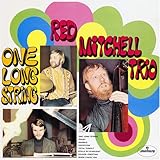
    Product DetailsThe Red Mitchell Trio "One Long String" (Mercury 1969) may have looked normal in 1969 when it was issued -- heck I had a Studebaker plastered with flower decals like those on the cover -- but as a reissue it just looks weird. And yet look at the players. Mitchell was a first rate, in-demand bassist who played alongside Ornette Coleman, Harold Land, Dizzy Gillespie, Phil Woods and on and on with a huge discography as sideman and leader, recognized for his large woody sound, creativity, and writing. He was 42 at the time of this recording and in the prime of his career. Bobo Stenson had yet to make an international name for himself and was still two years away from his first recording as leader, but already was a remarkably limber pianist. Drummer Rune Carlsson was a fixture on the Scandanavian scene who would go onto a long career backing Stenson and others in Europe as well as visiting Americans like Bill Evans and Ben Webster. Mitchell had moved to Sweden at the time of this recording, which is a very open, modern bop effort with a great deal of energy provided from his bass and the drumming of Carlsson. Stenson gets a chance to really open up on some soulful, energetic and wholly exciting tunes, mostly by Nash but also one by Stenson as well as the standard "Stella by Starlight." Close your eyes if you must but seek this one out and enjoy.

    The first two CDs herein were by established, recognized players, maybe not of the highest profile but still recognizable names. What happens when a relative unknown produces a marvelous CD with a whacky cover? That is what we have with Igor Butman's "Magic Land" (Sony 2007). Butman is on the cover with his ear over the bell of his saxophone, with the title splashed in multi-colors. It does not scream serious music -- it screams goofy -- and does not invite one to pick it up -- who is this anyway? Is he for real? But if you do pick it up and flip it over, here is what you get: a band that inlcudes Randy Brecker, Chick Corea, Jack DeJohnette, Stefon Harris, and John Patitucci. Now are you interested?

    Yes, this is one of those CDs where you need to look past the leader to the sidemen, and oh what sidemen. Does anyone believe that they would be playing behind a no-talent sax player? So who is Igor Butman?

    Product DetailsBorn in Leningrad in 1961, Butman was provided with a musical education from an early age, first on piano and then at age 11 on clarinet. He studied at top institutes in Russia, and then played in several major Russian bands. He picked up the tenor saxophone along the way for the charts in one of these bands, and never looked back. Butman, who had taught himself English, played with Gary Burton’s band during its 1982 tour with Chick Corea. In 1987 he came to Berklee and afterwards, with degrees as concert saxophonist and as composer, Butman went to New York where he played with Billy Taylor and Grover Washington Jr. first and later with Dave Brubeck, Lionel Hampton and Pat Metheny. He also formed bands for tours at home with John Abercrombie, Cindy Blackman, Joe Locke, and Adam Nussbaum. In 1998, Butman was guest soloist with Wynton Marsalis’ Lincoln Center Jazz Orchestra. He owns a club in Moscow and has brought jazz to Russia; in addition to his jazz, Butman has played and recorded with classical violinist Yuri Bashmet and his Moscow Soloists Chamber Orchestra. He currently continues to play and also now produces jazz recordings for his own recording label.

    This is a very nice album, not earth-shaking or amazingly innovative, but a very solid outing featuring a mix of songs that include some Carribean influenced phythms and harmonies, some ballads, some bop, and some lullabyes. Brecker is a standout on the CD, and Harris' vibraphone adds a flair on those Carribean sounds, and Butman has a smooth tone and plays some lovely melodies particularly on the slower tunes. The band impresses throughout.

    Got any other funky covers to share that hide solid outings? Let me know.


    Thursday, January 3, 2013

    Get to Know: Claire Daly

    Last February 14th I wrote a post on baritone sax players, and included in it Claire Daly, who is one of today's foremost practitioners on the instrument. In October 2012 she released he lastest effort, "Baritone Monk" (North Coast Brewing Company 2012) and it is terrific. And according to the brewery's site, all proceeds from the CD will go to the Thelonious Monk Institute of Jazz, so even better.

    Often the question is asked "Do we really need another Monk tribute?" I cannot answer it for the jazz community at large, but I can for myself: if it is a good as this one is, then of course.

    As background, here is what I wrote about Claire Daly last year. Claire Daly began playing the saxophone at age 12, and according to her biography, "was soon turned onto jazz by way of a visit with her father to a concert that featured Buddy Rich with his big band". The excitement of the night led her to take up the sax in earnest and led to her musical studies at the Berklee College Of Music. She turned professional in the late 1970s and  played tenor sax with both jazz and rock bands. Gradually moving over to jazz full time, she switched to the baritone saxophone.She cites her influences on baritone as Serge Chaloff, Ronnie Cuber and Leo Parker.  In the 1980s she had an extended seat in the all-female big band Diva, and worked with pianist Joel Forrester in People Like Us. She is another of the versitile baritone players like Ronnie Cuber, and moves easily between jazz, R&B and Latin. In 1999 she produced her first CD as a leader, "Swing Low" (Daly Bread 1999), which shows her  to be a gifted improviser with a deep, round tone, and a wide range of emotion in her songs.

    Since her debut disc in 1999, according to her web site she has gone on to produce eight other CDs, with this recent Monk outing her most recent one. Her band includes Steve Hudson on piano, Mary Ann Sweeney on bass, and Peter Grant on drums. The group hews pretty closely to the Monk tune's with a big sound and well-coordinated comping and creative solos that bring the standard Monk tunes to life. There is a casual feel to the music that can only be achieved by a band that has worked together and knows each others' playing, so that the music feels robust for the listener. Daly is the dominant voice and her big tone, round and mellow sound, and phrasing in the Monk style come through clearly, but each player gets plenty of space to improvise and solo. Grant drives the music along without overwhelming it, using his brushes and high hat to great effect. Daly surprises and pleases with her flute play on "Pannonica", which is a knockout imparting special beauty to this lovely melody. On the other hand I was not overly enamoured of Daly's singing on the closer, "A Merrier Christmas/Stuffy Turkey." But one song hardly diminishes what is a really solid outing. Highly recommended.

    New Year, Old Music

    Live at the Village VanguardI have begun the new year by listening the last two days to the music of Wynton Marsalis' Septet on his seven CD box set "Live at the Village Vanguard" (Columbia 1999). While I have tried to focus on the unknown, the new, and the under-appreciated in my posts, I felt a strong urge to listen to Marsalis and to give him his due as a musician. 

    There has been so much discussion about Marsalis, and his views on jazz, his feeling towards modernism, the third stream, electronica et al, that sometimes I think his actual musical contributions have become obscured and his music under-appreciated. I'm not sure it's "cool" to buy a Marsalis recording anymore, unless it's Branford doing his "Four MFs Playin' Tunes", a great recording in 2012, and that is really too bad. I've often noted I am not a critic, just a listener, and as such I get a lot of enjoyment out of many Marsalis' recordings, going back to his debut, through Black Codes, and more recently to his interesting collaborations with Richard Galliano, Eric Clapton, and Willie Nelson which while not spectacular are very listenable/enjoyable.

    The "Live at the Village Vanguard" box stands out to me, with its recreation of seven nights at the club taken from his performances over a five year period that include welcomes and set breaks along with a myriad of great tunes and play by an outstanding band: Wessell "Warmdaddy" Anderson on alto sax (a personal favorite of mine), Victor Goines on tenor, alto and clarinet, Wycliffe Gordon on trombone, Eric Reed or Marcus Roberts on piano, Herlin Riley on drums, and Reginald Veal or Ben Wolfe on bass. The live sets allow the band to stretch out, to improvise and create, which takes many of the standards in new directions often with more passion and energy than heard on the more staid studio recordings. As a result the music feels fresh, even by today's standards; "Embracable You" spins out into some very modern sounding harmonies and interplay among the band members, while "The Arrival" provides a lot of room for some more mainstream soloing by Marsalis on a muted trumpet and by Reed on piano. The band covers a wide range of styles including New Orleans jazz, mid-century swing, and firey post-bop, mixing standards and some of Marsalis' own pieces, and each member gets to strut his stuff throughout the over 8 hours of music. And the audience clearly is appreciative at each performance; listen to them after Monk's "Misterioso"  for just one example of many. Other melodies include "Black Codes from the Underground", "In a Sentimental Mood", "I'll Remember April", "Evidence", and a rousing "Majesty of the Blues" and special trumpet solo for "Buddy Bolden."

    Perhaps this is not an earth-shaking CD, but it is a terrific snapshot of a wonderful band playing some classic jazz in an iconic setting. To me it is a document worth having and enjoying.