Monday, April 29, 2013

Qui est George Robert?

George Robert is a terrific saxophonist and Director of the Jazz Department at the University of Applied Science Western Switzerland in Lausanne. Born in 1960 in Switzerland, he began his musical studies at a young age and by nine was enrolled at the Conservatoire de Musique in Geneva, where he studied clarinet. At 20, he enrolled at the Berklee College of Music and studied alto saxophone, graduating in 1984 with a Bachelor of Arts in Jazz Composition & Arranging Magna cum Laude. He stayed on in New York and in 1985 received a full scholarship to study at the Manhattan School of Music where he played lead alto.  In 1987 he earned a Master of Music in Jazz Performance at the Manhattan School of Music. In addition to free-lancing with such notables as Billy Hart, Buster Williams, the Lionel Hampton Big Band, and the Toshiko Akiyoshi-Lew Tabackin Jazz Orchestra, he formed the George Robert Quartet which earned the Down Beat Award for Outstanding Performance and was invited to perform on the main stage of the 1984 Montreux Jazz Festival.


In 1987 he formed the George Robert-Tom Harrell Quintet, a group from 1987 to 1992 that  recorded five albums. He later moved to Canada, and toured that country as well as the world with his quartet, featuring  Dado Moroni, Isla Eckinger and Peter Schmidlin.  

In 1995 George was chosen as Director of the Swiss Jazz School and returned home to lead the program for the next 11 years.  In 2003 he founded the Swiss Jazz Orchestra and earned the Suisse Foundation Award for his outstanding international career. He also toured with Phil Woods during that period and recorded several CDs with him.

He has had a long-lasting musical partnership with Kenny Barron and has toured Europe with him and together they have a number of recordings. In 2006 George moved to Lausanne and was hired as Director of the newly-created Haute Ecole de Musique de Lausanne which has the only jazz department in the University of Applied Sciences of Western Switzerland (HES-SO), the largest university in the country.  In 2009 he was honored by the French government and received the medal of Officer in the Order of Arts and Letters, in recognition for his outstanding international musical career.

Throughout his career Robert  has recorded well over fifty albums as a leader and performed with a who's who of modern jazz: Toshiko Akiyoshi, Jeff Ballard, Kenny Barron, Giani Basso, George Benson, Jerry Bergonzi, Randy Brecker, Brian Bromberg, Ray Brown, Terri Lyne Carrington, Bill Charlap, John Clayton, Jimmy Cobb, Billy Cobham, Chick Corea, Eddie Daniels, Jesse Davis, Joey DeFrancesco, Paquito D’Rivera, Billy Drummond,  Jon Faddis,  Paolo Fresu, Hal Galper, Benny Green, Larry Grenadier, Johnny Griffin,  George Gruntz, Charlie Haden, Jeff Hamilton, Lionel Hampton, Slide Hampton, Tom Harrell, Billy Hart, Louis Hayes, Jimmy Heath, Fred Hersch, Billy Higgins,  Daniel Humair, Hank Jones, Lee Konitz, Diana Krall, Michel Legrand, John Lewis, Dave Liebman, Joe Lovano, Russell Malone, Phil Markowitz, Cecil McBee, Ron McClure, Bobby McFerrin, Jim McNeely, Bob Mintzer, James Moody, Dado Moroni, Lewis Nash, Adam Nussbaum,  Nicolas Payton, Alvin Queen, Rufus Reid, Alex Riel, Claudio Roditi, Renee Rosnes, Wallace Roney, Arturo Sandoval, Bud Shank, Lew Tabackin, Clark Terry, Toots Thielemans, Steve Turre, Mads Vinding, Kenny Washington, Peter Washington, Frank Wess, Buster Williams, Jimmy Woode, Phil Woods, and many others.

So why is he largely unknown in the United States? Most likely becuase his CDs as a leader have been on European labels like TCB, Mons, and GPR so they are not well-publicized here. He first came to my attention a few years ago with the CD "Inspiration" (TCB 2000) as I was looking through Kenny Barron's catalogue and noted how he had often played as a sideman to George Robert. On this particular CD he was joined by Rufus Reid and Kenny Washington. Given such a powerhouse trio behind him, I figured that M. Robert had to be an outstanding saxophonist, and I was proven correct. Since that time I have invested more time and money into M. Robert's catalogue, purchasing "Peace" (DIW 2003), a duo with Barron on the Japanese import label; and several others.

Product Details"Inpiration" is taken from a live concert in Lausanne in 1999 with the aforementioned trio of Barron, Reid, and Washington. Robert on alto saxophone is out front and wrote six of the eight tunes. This a a group that knows how to swing. The two covers are "You Don't Know What Love Is" and "East of the Sun". Dedications are clear from the song titles -- "Blues for C.T." to frequent partner Clark Terry, "My Man Kenny" for Barron,  "Dexter" for Dexter Gordon, "Cannonization" for Cannonball Adderley, and even "Mom's Song."  The tribute to Terry is a lively upbeat blues song with a hard driving melody line, while "My Man Kenny" is as one might expect a toe tapping hard bop/post bop piece. Robert has a nice tone on alto and high speed delivery that avoids shrillness, and can really blow it out like on "Cannonization." And Barron picks up the same groove when he comes in, and then Reid to the continuing delight of the audience.  The embodiment of Robert's sound and taste is beautifully heard on the warm and lyrical interpretation of "You Don't Know What Love Is" as a duo with Barron. The trio is fabulous, with Washington pushing the beat and livening the music and some nice soloing from the big sounding Reid. But it is the sophistication of Barron that stands out as Robert's partner as the two trade melodies and imporvisations seamlessly. Barron's touch on "Mom's Song" is a joy to behold when he takes the reins from Robert after his own stirring opening. And Reid doesn't let up with his solo either. Clearly these guys all love their mothers.  

Product Details"Peace" is a duo recording by Robert and Barron that is long on lyricism and creativity, as the two tackle three Robert  originals, "Song for Abdullah" by Barron, and six covers including a stunning "Soul Eyes" "Softly as in a Morning Sunrise" "I Didn't Know What Time it Was" and "'Round Midnight." Once again the touch of Barron and alto tones of Robert are well matched to bring out the melodies and emotions inherent in the music, whether they be in the ballads or in the spritely delivery of "Blue Monk." And Barron stuns with his introduction to "'Round Midnight" and the solo outing on "Song for Abdullah."

Once you hear these CDs you'll wonder why George Robert is not a household name in jazz, at least in the U.S. His tone, expressive play, and choice of partners is impeccable, as demonstrated on these and other recordings. This is mainstream music of the highest order.

Three Quick Hits

From the pile, picked out a few CDs this weekend to listen to that are worth noting.

Product DetailsFirst, I love the movie "Midnight in Paris." I watch it everytime it shows up on cable, not that I don't own a copy on DVD anyway. After all, it's Paris, it's the jazz age, and it's a charming and nostalgic romance. The CD is well worth the listen too -- "Midnight in Paris" (Madison Gate Records 2011). Woody Allen has a great track record for picking music for his movies and this is no exception. The entire score sounds like music recorded during the period and yet most of it was recorded within the last decade, including the wonderful vocals by Conal Fowles,  specifically recorded for the movie. And who knew when watching that Mr. Fowles is not a jazz singer but rather a folk singer -- his voice is old-timely, his intonations great, and the joy in the songs like "You've Got that Swing" are charming. When the CD opens with "Si Tu Vois Ma Mere" with Sidney Bechet on clarinet I am immediately transported. For lovers of the jazz age and its music, this is a must.

Product Details
Ran Blake and Anthony Braxton spontaneously recorded togther in Vienna in 1988, and the resulting CD is "A Memory of Vienna" (Hatology 2009) a positively wonderful pairing of two idiosynchratic musicians having a great time with a number of standards. The music is always as unique as the two musicians but never too far off-center, and the word that comes to mind for this outing is soothing, perhaps a surprising choice of adjectives. The songs are beaqutifully interpreted and a pleasure to the ear. "Round Midnight" kicks the CD off nicely with Braxton on the melody, and "Yardbird Suite" follows with a remarkably bluesy, slowed down tempo featuring Blake upfront and Braxton following with his simialrly bluesy, noire take.  Other standouts are "Alone Together", "Soul Eyes", and "I'm Getting Sentimental Over You", but all eight tracks are great.  Modernism with soul.

Product DetailsLastly, the pairing of Mike DiRubbio and Larry Willis on "Four Hands, One Heart" (Kaanti Records 2011) is an exercise in romantic pianism by two outstanding soloists working together on sax and piano respectively. The two communicate their emotions beautifully in eight pieces including another lovely "Round Midnight", "Star Eyes", "Milestones", and "Alone Together." Lush mainstream interpretations, burnished sounds, outstanding.

Friday, April 26, 2013

The Early Robert Glasper

Three years before his debut as a leader with "Mood" (Fresh Sound New Talent 2004) and six years before his breakout CD "In My Element (Blue Note 2007), his second on Blue Note, Robert Glasper recorded a piano trio set under the leadership of Robert Hurst entitled "Unrehurst Volume I" (Bebob Records 2001). A bit of a surprising title, since the next set for the trio did not get recorded until March 2007 and released until 2010 as "Unrehurst Volume 2 (Bebob Records 2010), after Glaper had established himself on the Blue Note label. By the way, in addition to Robert Hurst as leader and bassist, the first volume had Damion Reid on drums and the second Chris Dave.

These are small gems worth finding.

Robert Hurst is a well-established bassist who has worked extensively with Wynton and Branford Marsalis. A native of Detroit, Hurst was born in 1964 and was first recorded in 1985 on a Blue Note CD with the group Out of the Blue, a young all-star ensemble tat included Kenny Garrett, Ralph Bowen, and Ralph Peterson among others. After two CDs with the group, he moved on to play with Woody Shaw and then for five years he played with the Wynton Marsalis Band. He then joined Branford as a member of the Tonight Show Band through 1995, and ocassionally with Kevin Eubanks thereafter. He has worked and toured with many others, including Geri Allen, Dianne Reeves, Vincent Herring, and Harry Connick Jr., and was part of the early configuration of the SFCollective.  

Product Details"Unrehurst Volume 1" is just one of many CDs Hurst has recorded as a leader. This is a wonderful set of rather uptempo, energetic mainstream jazz. It has seven tracks, several of which are extended to about 10 minutes to allow everyone to fully explore the songs, their instruments, and their imaginations. "Mr. Thomas" steps up as the first track and sets this tone with its classic melody and fiery improvisations, particularly by the young Glasper. In other cases there is the latin-tinged  "Unflurgenized Colorations", a ballad called "April Foolproof", and some mid-tempo bluesy sounds on "Dr. Bleuss" and "Bu Waynea".

Product Details"Unrehurst Volume 2" picks up Hurst and Glasper, along with new drummer Dave, in a recording session in 2007 at the same time "In My Element" was being released to outstanding reviews. The music was held until 2010 and then released and is another fine example of straight-ahead jazz by the trio. This time there are only five songs, three of which exceed 15 minutes but yet are tightly controlled and not given to much in the way of noodling. Hurst wrote two songs and Glasper one, and the others are "I Love You" by Cole Porter and "Monk's Dream" by Thelonious Monk, the latter a particularly outstanding interpretation.

I think any fans of Glasper or Hurst,  and fans of mainstream piano trios will find these two CDs to be outstanding efforts.

Thursday, April 25, 2013

CD: Newport Jazz Gala!

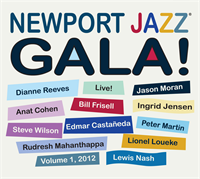
Newport Jazz Gala! LTD Edition CDFor those of us who did not get to Newport to see the jazz festival, the new CD from ArtistShare at least provides a snapshot of some of the participants as they performed in some unusual combinations at the Newport Festival Foundation Gala on August 4, 2012. The CD is called simply "Newport Jazz Gala" (ArtistShare 2013) and it inlcudes nine entries by a host of musicians. These are not from the sets played for the public, some of which you can hear via NPR, but rather a unique portrait of jazz covering a wide range of sounds, instruments, and groups in a single setting. A brief walk-through of the songs and players should be sufficient to intrigue most readers of this post.

First up is Dianne Reeves singing "I'm in Love Again", accompanied on the piano by Peter Martin, a nice standard way to start the set. The sound quickly turns more improvisational with "Three's Free", a freely imporvised piece played by Anat Cohen on clarinet, Ingrid Jensen on trumpet, and Jason Moran on piano. To start, Jensen introduces a phrase, then Cohen picks it up, followed by Moran. Then the trio begins to elaboraate upon the phrase, offering in turn solo riffs, and finally all three join in once the theme is fully established. A remarkably spry and lovely piece highlighted by the beautiful rich sounds from each master, but for my ears particulalry by Cohen playing across all three octaves of the clarinet.

Third up is "Aurora" a piece both written by and played by Rudresh Mahanthappa that is very much in keeping with the sound of the recently released "Gamak" (ACT 2013). His support is not identified but there are some traditional Indian percussion parts supporting him along with some electronic feedback and echoing. all in all a very modern and avant garde piece. "Merci" is next, a duet of Lionel Loueke and Jason Moran that is lively and fun. Loueke begins with any number of vocalizations including hums, clicks, and pos along side his guitar work. Moran enters as support a bit later first compling and then playing a melody line in support of the rhythmic play from Loueke and then taking over the melody while Loueke "plays" the percussion for the better part of three minutes. Finally, Loueke sings his part in his native language backed quietly by his guitar and Moran's piano. Lovely.

Lewis Nash on drums and Steve Wilson on sax cut it up with the "Jitterbug Waltz" next, followed by Edmar Castaneda playing two of his own compositions -- first soloing on "Entre Cuerdas" and then dueting with sax player Wilson on "Double Portion". Castaneda is probably the least known player on this CD; he is a 35 year old harp player from Bogota, Colombia now located in New York. His most recent CD has him leading a group which includes Gonzolo Rubalcaba on piano, Miguel Zenon on saxophone, and Hamilton De Holanda on mandolin. He plays what might be expected from the harp -- lush, long flowing melody lines and strong melodies that shift across the octaves to create intriguing expressive pieces. These are really outstanding contibutions to the CD from a wholly unexpected source, whether playing solo or comping behind a very interesting melody played by Wilson on the second piece.


Finally two last pieces. The first is just a great interpretation of the Beatles' "Come Together" by Anat Cohen on clarinet and Bill Frisell on guitar. Frisell of course did a complete CD a couple of years ago featuring John Lennon's music and this has the same combination of the familiar and the unexpected, with Cohen once again starring on the clarinet. So simple, so fun.  Finally, there is the ensemble of Frisell, Jensen, Moran, Nash, and Wilson playing, or in fact playing around with, "Blue Monk" a suitable closer to what must have been a great night. 

Edgy Pianists: Marilyn Crispell and Kris Davis

Continuing with my current fascination with the extremes of pano play, here are two works that are sometimes pretty hard on the ear and yet are captivating to listen to. They fall right at my previously described edge, the Matthew Shipp/Lisabeth Salander line.

Product DetailsThe earlier entry is from the end of 2012 and is "Marilyn Crispell-Mark Dresser-Gerry Hemingway Play Braxton (Tzadik 2012), with the three players respectively on piano, bass and drums. All three share a strong bond with Anthony Braxton, the very knotty avant garde genius of the woodwinds, having spent 1985 -94 in his quartet. And this is very knotty music indeed, a set of five pieces that the trio carefully selected from the vast repetoire that to them represents the breadth and genius of the master.  This is not music for the faint of heart but rather for the adventerous and lovers of the abstract. And it is not Marilyn Crispell as she is heard on her lovely and atmospheric ECM cds.

"Composition 116", the opening piece, sets the stage right away as it opens with a cluster of dissonant chords over sharp drum play, and then gradualy leads into long lines of spiky, well spaced chord play. Crispell's touch is firm and close to staccato as she goes up and down the keys with these clusters, matched closely underneath by resounding drum notes. The entire five minutes is filled with tension, created by the hard piano touch, chords, and jagged lines without any sections played with different dynamics or speeds. And still I liked it, a very modernist piece of music that toes the line between structure and total anarchy nicely.

"Composition 23c" is the second piece and its difference is signaled right away by the opening with a subdued bass solo, followed by some simple and melodic piano. The piece is more soothing with a softer touch and no dissonance. It is still very modern as there is no real sense of a melody; it is more an experimentation with making sounds together either in unison or as supporting players. "Composition 108c/110/69q" is another tune that begins with a very pretty piano part, a bowed basss line and toms underneath. It features the bass in support under the piano and then in response to the piano. It is pleasant to the ear. In the middle of the piece is a riveting pizzicato bass part, and then a very traditional sounding jazz drum solo.

"Composition 69b", the fourth piece, returns to the more harsh sound of the first piece, although it opens with a trio part of subdued chords that gradually merge into a surging set of runs up and down the keyboard. As the piece goes on its dynamics increase, the parts gets sharper and more angular, and eventually the piece begins to sound frantic with hard chordal play, very strong, banging piano chords, and hard drum support. Its not hard to listen to but it is frenetic and pushy. Finally, "Composition 40n/40b" closes the set with the longest piece at twelve minutes, a slow and quiet piece with little piano bursts, a quiet bowed bass, drum colorations, and lots of space. It is very ECMish as it builds from the separated sounds into a more breezy and mellow section with a nice plucked bass over a moving piano that sounds as melodic as anything that came earlier. It almost creates a mainstream jazz feel to round off the CD.

A challenging but ultimately rewarding CD for those who tilt to the far end of the spectrum.

CF268Kris Davis first came to my attention last year with Aeriol Piano (Clean Feed 2012), a stunning set of modernist piano solos. She is back here on Capricorn Climber (Clean Feed 2013) with a quintet: Mat Maneri on viola, Ingrid Laubrock on saxophone, Trevor Dunn on bass, and Tom Rainey on drums. This is music at the edge too as one would expect from this grouping and the label, but again has a great deal of things to offer in terms of fascinating melodies, intersting combinations, and the outstanding sounds particularly of Davis, Laubrock, and Maneri. I do have to note that there are sections that do go a bit far out for me as they involved some odd sounds and combinations.

This is music out of the New Yrok City downtown scene with all the associated images one has of its music. It is a CD of varying extremes: mellow and edgy, free yet structured, flowing and abrasive, quiet and heated. The music at times can be unsettling and full of nervous energy and at other times incredibly peaceful and unhurried. At times the musicians are in in synch and the music is almost chamber-like with the piano, viola and bass play, while at others it is well out there and full of dissonance and arrythmic play.

Product DetailsDavis has said in interviews her goal is to blur the line between what is written and what is improvised. The songs have a lot going on and can get very dense with sounds at times, but there are always pockets of open space and quietude that allow for experimentation. As I noted, the rhythms can change on a dime and can even seem to vary among instruments playing at the same time, so it is only the strong directorial play of Rainey on the drums and Dunn on the bass that keep the structures for each piece in place. This is quirky music, full of mischief and surprise, sometimes not all that pleasant to the ear but manageable to my ear nonetheless and those parts do not last for long spells compared to the rest of the ensemble play. Sometimes consonant and sometimes dissonant, even in a single piece, the music captures the imagination and interest. Pieces begin quietly and build in tension, dynamics and tempo, heating up quickly to amazing sounds, and they can break just as quickly. Tension and release, tension and release -- a constant to the set.

‘Too Tinkerbell’ opens the set with bowed viola and bass as if this will be a chamber piece, but then quickly the piano comes in with some off-center chords and a tinkling melody on the piano's highest octave which shifts the sound into a more modern texture.  The sound gradually builds, the piano  dynamics increase, the tempo gets a bit more fevered and then suddenly a break and the song goes into a very still atmospheric section with no melodic lead, just sounds and phrases and fragments from each player. This settles the piece nicely and reduces the frenetic feeling from the opening section.

“Pass the Magic Hat,” begins with a nice little piano solo over a syncopated groove, which is followed by the entry of the saxophone in concert with the piano melody. The song sounds like a pretty traditional modern impressionistic jazz piece as the sax enters and plays a nice counter-melody with Davis' piano. Lubrock is restrained and mellow for this piece even as the heat rises in this section. Harmonically simple its a really lovely piece of modern jazz. A break leads to a Maneri lead over some very quiet support, and then the work builds as all the instruments join in and settle into a nice quiet jazz groove. Ten beautiful minutes.

“Trevor’s Luffa Complex,” is named for Trevor Dunn and I guess his loofa. It starts quietly with the bass opening with a nice moving part, and then a melody is introduced on glockenspiel with a quiet sax part underneath. Gradually the dynamics increase and the sax comes out of the background to introduce Laubrock’s tenor solo. The sound is restrained and mellow at first and then gradually the tempo and heat rises, supported by the increasing complexity of the drum part and strong comping from Davis. The sax sound gets a bit harsher, the notes begin to flurry a lot more, and all the quintet's components get in on the action.  A quiet section follows a break and Maneri opens the next section with a meandering viola over some simple piano figures. The quiet of this part once again releases the tension.  After a few minutes they are are back in the groove with everyone playing, with much counterpoint and playing against time, play between consonance and dissonance, and building and resolving tensions. Like the previous piece the music runs the gamut from soft to loud, solo to ensemble, and calm to frenetic.

The title cut "Capricorn Climber" fits the same pattern, a quiet opening builds to a crescendo of intersecting parts by all the members, a bit feverish and chaotic. Graually the saxophone and viola emerge with a nice relasing section, which in turn heats up into a finish full of furious sounds, drones, and energetic play.

And so it goes, a CD of great interst and great contrasts. Parts of extreme quiet and beauty, parts of swirling energies and discordance, all in a fascinating stew of modern avant garde jazz.

Monday, April 22, 2013

Extreme Piano Listening: 8 CDs of Note


Took another ride to New Jersey recently. Packed a few new CDs in the car to listen to and off I went. As I listened to the music I had brought, which featured piano-based sets, I got to thinking about how different they were from one another. On the one hand I had smoothly traditional standards jazz (and I do not mean smooth jazz), on the other some avant-garde spiky modernist renderings. And in the middle I had those lyrical and impressionistic CDs that don't fall heavily to either side.

Which brought me to thinking about the continuum of piano-based jazz, or at least my continuum from the time of bop onward (In other words no ragtime, no pre-WWII), which really is a further definition of my categorizations from my "Best of 2012" post, but this time using players and not descriptive categories. I decided that I can define my poles pretty easily:

  • At one end, and in this case for whatever reason I think to the left on my scale, are the classic stylists of mainstream jazz, defined for me by Oscar Peterson, Hank Jones, and Andre Previn. Strong with the melody, simple but classic with  the improvisations, harmonic, and elegant players. Adjectives: Smooth, elegant, stylish, classic, lyrical, traditional, easy. Persona: Sean Connery as James Bond.  

  • At the other end, to the right, the furthest I go would be defined for me pretty much with a single player, Matthew Shipp, who takes the music as far in that direction consistently as anyone in my collection, though at times others do as well but not as consistently -- Uri Caine, Marilyn Crispell, Myra Melford. Adjectives: Spiky, discordant, intense, demanding, polyphonic, modern, abstract. Persona: Lisbeth Salander in the Girl with the Dragon Tatoo.

The largest group of pianists clearly falls in between and can be cut up and defined in so many ways. I chose modern mainstream, modern lyrical, and modern impressionistic for categorizing my 2012 recordings.

So what was I listening to that provoked these thoughts and images?  Here they are

  • Product DetailsAaron Diehl, The Bespoke Man's Narrative (Mack Avenue 2013) is a wonderful set of straight-ahead music produced among a quartet of outstanding players -- Diehl on piano, David Wong on bass, Rodney Green on drums and Warren Wolf on the vibes. Very much to the smooth end of my hierarchy (and again that does NOT mean smooth jazz), well-structured and played peaens to some great music like "Moonlight in Vermont" and "Single Petal of a Rose" as well as several pieces penned by Diehl all emphasize how formidable each player is and how beautiful they sound when playing together, as a sort of new MJQ. And a special tip of the hat to David Wong, whose playing I find formidable as always (see earlier posts). Bespoke for sure, and who is more bespoke than Sean Connery as James Bond? 
  • Product DetailsNoah Haidu, Momentum (Positone 2013) is another pianist from the smooth side of the continuum who follows 2011's "Slipstream" (Positone 2011) with another set of mainstream jazz, a trio this time with Ariel de la Portilla on bass and McClenty Hunter on drums. Haidu's set consists of four originals and five covers, with the covers being of some lesser known but wonderful songs like "I Thought About You" from Jimmy Van Heusen, "Serenity" by Joe Henderson, and Keith Jarrett's "Rainbow". More familiar and lovely are "The End of a Love Affair" and "A Child is Born." Haidu's trio play is straight down the middle, with the melodies clearly stated and the improvisations tightly wound and shiny. Very lush and beautiful music.
  • Product Details
  • Steve Kuhn, The Vanguard Date (Sunnyside 2013) is a re-release of a set at the Village Vanguard recorded in 1986 and released on the Owl label. Kuhn leans well to the smooth end of the continuum but to me has a bit more flair with his interpretations of melodies and is freer and more creative with his improvised sections. He shares his set with his partners Ron Carter on bass and Al Foster on drums, two outstanding veterans with a similar ear for melody, harmony and improvisation. Half the pieces are originals, with one of them from Carter. This CD also covers "I Thought About You" at double the length of the Haidu version, which provides the time for a great deal of exploration by each member of the trio, and yet the two versions are remarkably similar with the emphasis on lush chords and long and lyrical lines. Kuhn is a master of dynamics, melodies and emotions and this is a beautifully captured romantic set.
  • Product DetailsAlessandro Lanzoni Trio, Dark Flavor (CamJazz 2013) moves the dial along the continuum towards a more modern, lyrical approach to sound and the interpretation of individual pieces. Melodies are less specific although lyricism and long lush harmonies rule the day, so the overall work is a pleasurable listen. This is a part of CamJazz' young talents series and a really sharp debut for Lanzoni, who joins with Matteo Bortone on bass and Enrico Morello on drums. His play features elements of classical music, the blues, and off course jazz as he lays down six originals and five covers featuring three pieces by T. Monk ---"Bright Mississippi", "Crepuscule for Nellie" and "Introspection." He smooths out Monk a fair amount but still retains the uneveness in the meter and approach that makes the songs Monk pieces. His own melodies are lyrical with long legato passages and plenty of interplay with a particularly strong tempo maintained by the bass and drum parts. When the CD starts with "Anatollo" it is clear immediately that this is a trio with a lot of promise by a new Italian pianist in the mode of Enrico Pieranunzi and Dado Moroni. Modern lyricism at its best in a great debut set.
  • Product DetailsEldar Djangirov Trio, Breakthrough (Motema 2013) moves a bit more to the middle of the scale, featuring a set with a wide variety of sources and moods played by the former piano prodigy Eldar, here with Armando Gola on basee, Ludwig Afonso on drums, and featuring Chris Potter on tenor sax on one piece and Joe Locke on vibes on another. Eldar has always been associated with showy play, fast runs and lots of dynamic changes, but here he has tempered his excesses into a set of eleven fascinating pieces. He still displays his speed, his emotions, and creativity but seems more controlled and aware of the interplay with his partners. What moves the meter more to the middle for me -- moving between modern lyrical and modern impressionistic jazz -- is his interpretation of the original melodies, his imaginative improvisations and his highly impressionistic originals that are based less on feeling the tunes and on emotion. "Point of View Redux" as opener immediately captures these themes in an original piece that is at times fiery, at other times romantic, and always lyrically driven. His interpretations of "Somebody Loves Me" and "What'll I Do", by George Gershwin and Irving Berlin respectively are full of lovely melody lines and lush chords and then lyrical improvisations on the tune that display creativity and romanticism. These are 11 pieces that are still heavily dependent upon conventional melodies and harmonies, but are expansive in the use of them to create some wonderfully new pieces. 
  • Product DetailsLisa Hilton, Getaway (Ruby Slippers Productions 2013) is a new outing of 13 original pieces by Hilton with Larry Grenadier on bass and Nasheet Waits on drums. It traces Hilton's moods and feelings from being on the road seeing new places and meeting new people. From the jangling and hectic "Getaway" to open the set to the fantastically beautiful pairing of " Stepping into Paradise" and "Evening Song", with a range of emotions, sounds, and tempi in between, this is the essence of modern impressionistic jazz for me. Each song and its title conveys different places, people and times of day and Hilton fully realizes her concept of taking the listener with her across the full range of her feelings. Hilton was once upon a time time thought of as a smooth jazzer but with her last CD "American Impressions" (Ruby Slippers Productions 2012) and this one she has blossomed into a modern jazz pianist to be reckoned with. I find this a knockout experience and one for those who love the mainstream or modern impressionistic jazz trio play.
  • Product DetailsCraig Taborn, "Chants" (ECM 2013) follows on the heels of Taborn's solo outing in 2011 on ECM "Avenging Angel" and is another very original set of nine pieces, this time in a trio with Gerald Cleaver on bass and Thomas Morgan on drums. This is clearly a partnership and not solely a piano-led trio outing, with all three instruments clearly driving the car at various times, or contributing interesting parts to make up a wonderfully rich and interesting listen. I confess that I did not have this with me on the way to New Jersey, but did have it in advance of tomorrow's release, and I did want to include it here as it moves the meter a bit more to the free and open, avant garde/spiky side of the continuum. But it doesn't fully reach that side -- it is not at all spiky and instead features a concentration on melodies and counterpoint, on a palette of varying sounds and atmospheric interest, and on the use of space to let the songs breath. Cool stuff that I categorize as modern free jazz, a category that I would include players like Jason Morn and Vijay Iyer in as well. Definitely not for those in the mainstream but in the wheelhouse of those liking new modernistic piano trios.
  • Product Details
  • Han Bennick with Uri Caine, Sonic Boom (816 Music 2013)  tips my needle fully to the modern, avante garde side with its wildly free range music by Bennick on drums and Caine on piano. Thus the picture of Lisbeth Salander, a great representation of the music herein. And yet not all of it can be characterized in that manner, as a song like "Furious Urious", an original sounds like something that would come out of any forward thinking modern mainstream jazz group. It has a strong melody, a flowing sound, and typical bass and drum rhythms propelling it. On the other hand, the CD starts with the drum set, then a series of short staccato piano notes forming a sort of melody that ranges around the entire keyboard, gradually moving into a more structured set of notes in the right hand with a still staccato undertone from the left hand and the drums. Not a traditional that quickly breaks down again into a free range set of chords, runs, and drum beats.  A really dynamic, adventerous, and highly pleasing modernistic approach to music. The second piece "Grind of Blue" opens as a more or less traditional sounding piece, with a quiet piano melody and supporting drums and switches gradually into a free form piece. "Round Midnight" is the sole piece here not written/free improvised by the duo and is a fascinating take. the melody is there in pieces but the construct is very different with lots of short runs and furious drumming, and then short pieces of softer sounds and lyricism. Back and forth and very captivating. Overall the CD is a fascinating combination of inside and outside sections, creative intellects at work, and dynamic play.
Eight CDs and I like them all, from the smoothest and most inside to the jagged and intriguing avant garde. See which fit your tastes, and even try to expand them. It won't hurt too much!


Wednesday, April 17, 2013

Get to Know: In the Country

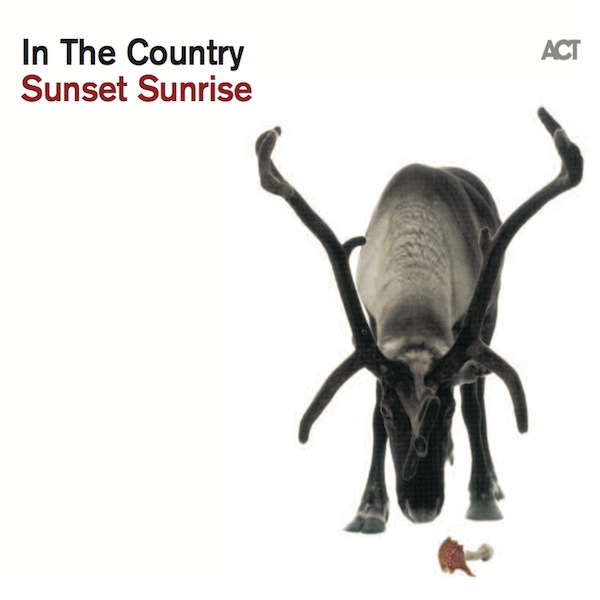
I wrote in the last post that ACT was a marvelous European label producing some of the best in modern European Jazz. This is a follow-up to that post presenting a very interesting, modern piano trio, In the Country. Recently the group released a new CD, "Sunset Sunrise" (ACT 2013) which is, according to their website, is their fifth album and first on ACT. I have three of the five, all of which are trios and studio recordings. I do not have the two live recordings, which also find the band augmented with vocals, guitars, and other instrumentation.

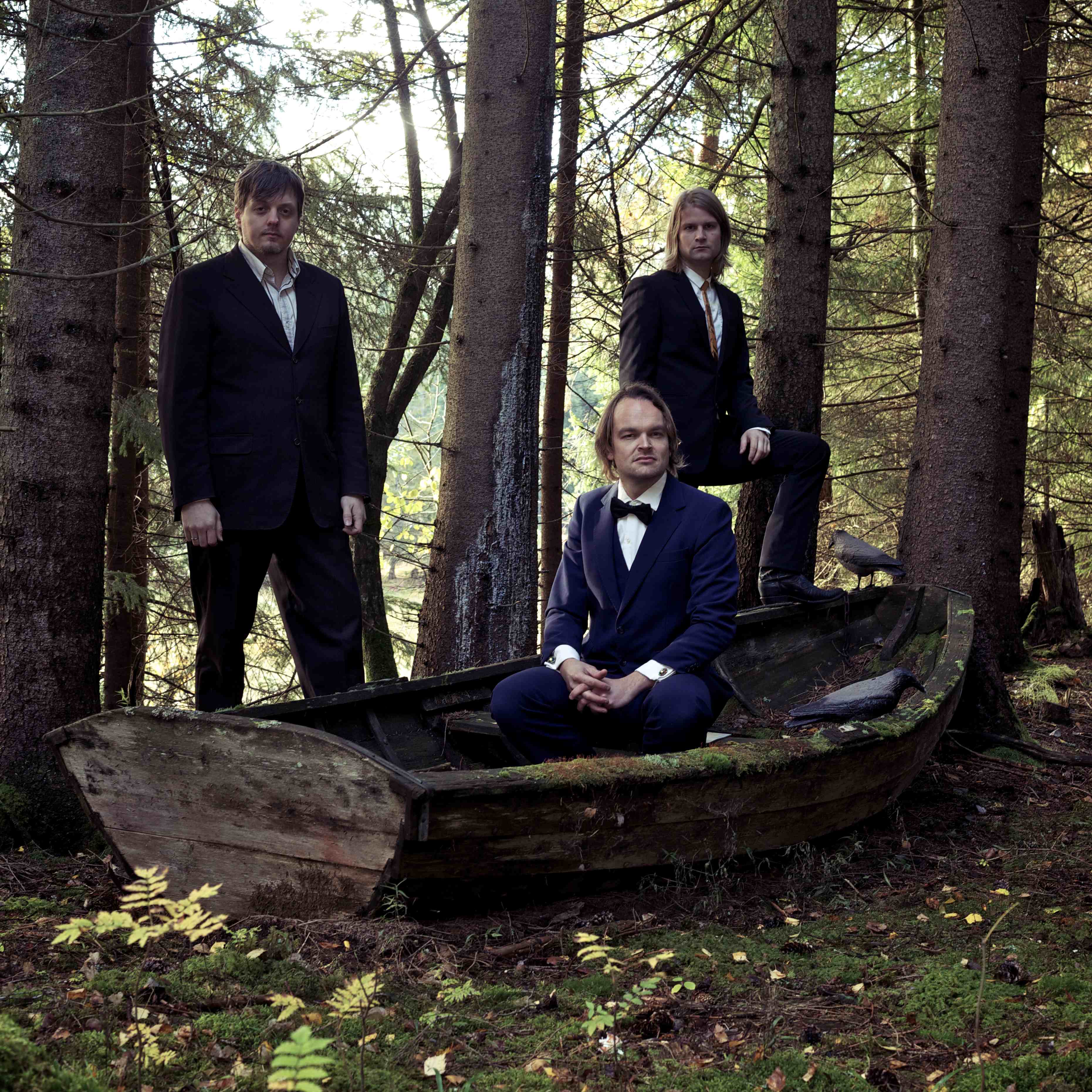
In the Country is Morten Qvenild on piano, Roger Arntzen on bass, and Pål Hausken on drums. The Norwegian  trio is celebrating its 10th yera as a band in 2013, and over the decade received such accolades as the award  "Best Norwegian Young Jazz Artists" and "Independent Music Award 2012" for a full length art concert film. All of the music on the new album was composed by Qvenild. In the Country is another in the line of European contemporary jazz trios that combines jazz tradition with modern pop music, european folk tunes, classical music, and world music; and occassionally adds electronic sounds and vocalizing to their basic accoustic sets.

The music of Sunrise Sunset is serene and quite beautiful to listen to, with flowing melodies and strong bass and drum support and colorings. Subtle electronics add to the color and depth in a non-obtrusive way. "Birch" begins the CD with a strongly moving melody that captures these combinations well, while the next piece "Derrick" has greater depth and mystery to it as the colorations are more intense and the use of the lower register of the piano a bit more ominous. The CD then switches to a lovely ballad "Stanley Park" that captures the spirit of contemporary players like Paul Bley, Keith Jarrett or John Taylor. Sheer beauty with a lovely bass part to boot. "Silver Spring" is another dark song of beauty, a sonic landscape reflecting the musicians' homeland. As the material goes on, the electronics provide some colorful background sounds that strengthen the depth of feeliings that the trio has for the North Country on "Steelpants", and the music gets somewhat bolder with "The Fluke -- A Whale's Tale" as sounds in the background suggest nature's own music. The title song "Sunrise Sunset" is an exquisite little poem, and the CD concludes with "December Song", another sonic tale of wonder and tranquility.  All in all another wonderful piano trio with a modernist touch from Scandanavia, a partoral set with a touch of electronic enhancement.
Briefly, here are some notes on the group's two earlier studio CDs.

In the Country: This Was the Pace of My HeartbeatRune Grammofon called This Was the Pace of My Heartbeat (Rune Grammofon 2005) their first jazz recording, and in fact is was the beginning of the unique sound of In the Country, as noted earlier a contemporary band that blends jazz tradition with modern pop, folk, and world sounds, and is not afraid to delve into a bit of electronica to boot for color.  No standards are to be found in their music, although in addition to Qvenild's compositions there is one clasical piece by Handel and one pop piece by Ryan Adams on the CD. This was seen at the time as jazz as performed by Bad Plus and E.S.T. with the marvelous sense of abstraction, although the sense I get is of a band that is more about quiet, free play, texture, and space with greater lyricism and more melancholy present than in the other two bands. this is more reminiscient of Bobo Stenson, Todd Gustavsen, and of the folk tunes from the north.This is an album of simplicity, tranquility, and beauty that immediately links In the Country to the Scandanavian tradition of  outstanding musicians like Stenson and Gustaven.
Product Details

In The Country's Whiteout (Rune Grammafon 2009) was a bit bolder and less understated than the debut CD above, but no less beautiful with compelling, deeply moving tunes and trio play. The group continues to take the songs of Qvenild into places filled with layers of sound, varying textures and tempi, and overall lovely places of great interest to the listener. The classical and gauzy feeling of  "From the Shore" is a moving opening to the CD, with deeply felt emotions, simple meoldy, and great use of space and tension. The group has included a bit more of the elctronica and voicings to increase its colorations. With  "Doves Dance" though, one can feel the influences of Jarett or Taylor in the piano soloing of Qvenild, as he ranges across the keyboard with such a feeling of freedom and joy with a bit of the old time religion in his hands. "Ursa Major" is a modernist, minimalist piece of polyrhythm's, intertwined play, and interest, while "Mother" is the closest thing to prog-rock/Bad Plus territory as it closes out the album with a steady beat, some synthesizer sounds, and heightened emotion. And watch after for a very pretty solo piano piece as a hidden track. In the Country took a step up with this CD over its predecessor, with a larger sonic palette and more experimentation with sound effects, but always within the structure of a marvelous acoustic piano trio.