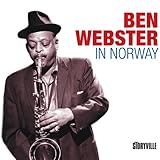
 #1 Ben Webster, "Ben Webster in Norway" (Storyville 2013): I can't get enough of Ben Webster and his big round and rich tenor sound. In 2012 there were the Stan Tracey Trio, UK Live 1967 Volumes 1 and 2 (Jazzhus 2012), which also included Ronnie Scott on several tunes that was fantastic. This year it's this release from 1970, eleven songs with a Norwegian piano trio playing classics from Duke Ellington ("In a Mellotone", "Cotton Tail", "How Long Has This Been Going On", and "Satin Doll") along with hits like "I Got Rhythm" and "My Romance." Perfect listening.
 #2 Tommy Flanagan and Jaki Byard, "The Magic of 2 - Live at the Keystone Corner (Reservoir 2013): A recording from 1982 brings together two classic pianists on eleven songs for the ages. Six solos, three by each player, and five duos where the two trade ideas back and forth, with a little swing, a little bop, a little stride, and a lot of imagination. Infectious and exciting, that night was "Just One of those Things" and now "Our Delight" to be able to sit in on. Beautifully packaged with a booklet and essays by Todd Barkan (the producer), Dan Morgenstern, Renee Rosnes and Bill Charlap, Howard Mandel, and Diane Byard. Great fun.
 #3 Oscar Pettiford, "Lost Tapes: Germany 1958/1959 (Jazzhaus/SWR Music 2013): This is another is the series of lost tape findings from Germany, and a particularly strong outing. Pettiford was coming off successful stints with Charlie Parker and Dizzy Gillespie, and was reinventing the use of the bass as far more than a timekeeper in jazz. Here he has sessions with some of the leading European players of the time -- Hans Koller and Rolf Kuhn are the most notable names -- and a number of high profile ex-pats like Kenny Clarke and Lucky Thompson. Lots to love here, including Pettiford taking up the cello several times, Thompson's play on "Sophisticated Lady", the clarinet of Rolf Kuhn, and late in the set the play of Kenny Clarke on drums. The lost tapes sets have been great and this one shines the most brightly so far for this listener. (Note: another fine set that came out late in the year featured the Modern Jazz Quartet.)
Numbers 4 through 8 are as follows:
 Tony Bennett and Dave Brubeck, "The White House Session, Live 1962" (Columbia 2013): Bennett and Brubeck at the height of their powers in what turns out were careers of long and extended power. I would have rated this more highly had they played together more; the classic Brubeck quartet opens with four pieces followed by six from Bennett before they join for the last four. Still, hearing live versions of songs like "Just in Time", "One for My Baby", "Take Five", and others is a delight to the senses.
 Duke Ellington, "The Duke at Fargo 1940" (Storyville 2013): A two-CD set captures the Ellington Band on the road as a true dance band during a U.S. tour. The sound is amazingly good for the period and the recording captures the excitement of the evening pretty nicely. Lots of music, lots of great solos.
 Multiple Composers and Players, "Jazz on Film Recordings 1957-62) French New Wave" (Jazzwise Jazz on Film Records 2013): This is the third box set of film scores produced by Jazzwise Magazine in England and it is a smashing set. Running down the music: "No Sun in Venice" The Modern Jazz Quartet; "Lift to the Scaffold" Miles Davis, "Les Liaisons Dangereuses " and "Des Femmes Disparaissent" Art Blakey and the Jazz Messengers, "Breathless" Martial Solal, "Un Temoin Dans La Ville" Barney Wilen, and "Eva" Michel Legrand. Comes with a nice booklet describing each film and score with a complete list of the players and photos. Lots of terrific music and musicians.
 Lester Young, "Boston 1950" (Uptown 2013): Uptown keeps finding and producing wonderful live sets from the clubs, and this one features Young at the Hi-Hat in Boston, with players like Horace Silver or Kenny Drew on piano, Connie Kay on drums, and Jesse Drakes on trumpet. Includes the radio introductions from Symphony Sid.
 Thelonious Monk, "Paris 1969" (Blue Note 2013): A late career recording of a pretty standard set of twelve songs by Monk, all nicely played. With Charlie Rouse still on tenor, but with a French bass and drummer until Philly Joe Jones sits in and raises the stakes towards the end. Monk sounds great to me and pretty engaged. First rate outing.


