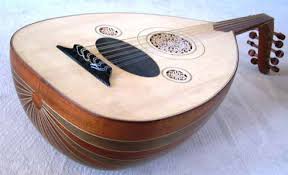
These are not really oddities, I just loved the pun. Onwards.
There are two discs of oud masters that I found recently in a used jazz bin. They date back to their beginnings as recording stars. Rabih Abou Khalil and Anouar Brahem are acknowledged masters of their instrument and of the eastern music/jazz intersection, but as I said, these are two of their earliest efforts.

In the case of Abou-Khalil it is his debut recording,
"Al-Jadida" (Enja 1991). For Brahem, it is Jan Gabarek's
"Madar" (ECM 1994). Both demonstrate beautifully the potential of the oud, tabla and other eastern instruments in jazz; both include the saxophone as an instrument that creates the link to jazz, with Gabarek the leader on his own recording, and Sonny Fortune on the Abou-Khalil disc.

I happen love the sound of the oud, and the introduction of it into the jazz genre. I am not really sure I can express why I feel this way, but I can try. And I can also refer you to the August 2012 issue of
Jazz Times, which has a lengthy article about the oud and oud players.
For me I think the first thing I can think of is a general interest and appreciation for the sound of eastern music, which probably dates back to my recordings in the 60s of Ravi Shankar, whose Indian music and sitar playing first introduced a lot of us to new sounds alien to our western ears. Another long-time exposure for me was traditional Israeli music and klesmer music. Finally, the oud mirrors my favorite type of guitar/stringed instrument playing, which is the full-bodied sound of an acoustic instrument. I find acoustic guitar, be it folk guitar or flamenco, or classical, to have a richer, more full bodied sound, with more layers, than the electric guitar.
Putting all this together, I find the oud to have a very senuous, rich and deeply felt sound. Being fretless and having 11 strings -- five paired strings and one bass string -- it can provide more tones using the eastern scale, and more subtle harmonies whichh add great depth, even when played with simpler western scales.
In short, the oud provides great coloration, a deep and rich acoustic sound, and a wide range of possible notes given its fretless neck and paired strings.

Rabih Abou Kahil is a Lebanese-born oud player creating a common ground between the Arab music of his roots and the global musicof today. Down Beat said his music is "a unique hybrid that successfully spans the world of traditional Arabic music and jazz." He learned to play the oud as a child, but switched to classical flute, and studied at the Academy of Music in Munich, Germany, during the Lebanese Civil War in 1978. When he returned to the oud he began to use techniques more often heard on jazz guitar, and from then on has worked on created a fusion of eastern and western music on his recordings.
Rabih Abou Khalil links the east and west in his selection of instruments on
"Al-Jadida", with Sonny Fortune on saxophone forming the strongest bond. Some of the music is boppish in Fortune's hands, yet the rest of the instrumation reflects both the eastern tradition, with percussion suggestive of African music. Abou-Khalil wrote all the music, and linkage of the classical western traditions, jazz, and eastern music is evident and reflective of his education. Titles like "Catania", or " Ornette Never Sleeps" suggest the western, while "Nadim" or "Nasbuwa" suggest the eastern. Overall the music has great harmonics, rapturous and sinous melodies, and very strong percussive undercurrents.

Abou-Khalil has gone on to great success, with numerous recordings on Enja, and has constantly changed his instrumentation to reflect his intrests, growth and experimentation with sound. I particularly am drawn to two recordings on which Kenny Wheeler plays a major role,
"Blue Camel" (Enja 1992) and
"Sultan's Picnic" (Enja 1994).
Blue Camel in particular is cited as one of Abou-Khalil's masterpieces, with a mood characteristic of
"Kind of Blue" according to AllMusic.com. It includes Wheeler, saxophonist Charlie Mariano, and bassist Steve Swallow from the western tradition, along with a number of eastern players on a range of percussion instruments. The fusion of east and west is extraordinary, and the melodies and harmonies mix both effectively to create an enchanting, seductive piece of music.
"Sultan's Picnic" also has Wheeler and Mariano, but introduces a harmonica to the mix, in the person of Howard Levy, to further experiment with sound.
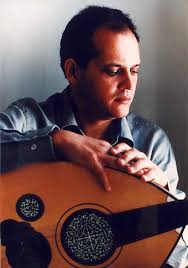
Anouar Brahem was born in 1957 in Tunisia, and began studying the oud at the age of ten as a student at the National Conservatory of Music. Although he initially focused on Arabic music, Brahem increasingly incorporated elements of jazz, and spect 1981-87 in Paris advancing his interests. He returned to Tunisia in 1987, and in 1990 he signed with ECM. His debut album,
"Barzakh" (ECM 1991) was recorded with Turkish musicians.
On his second recording, Brahem was listed as a sideman. This was
"Madar" , a recording of Jan Gabarek, but given the stripped down ensemble -- the only other player was Ustad Shaukat Hussain on tabla -- he had a major role in shaping the melodies and in providing supporting harmonies. Together Gabarek and Brahem produced a distinctive sound and some distinctive melodies, including some that merged Norwegian folk songs with the eastern instruments. The tabla play is strong and helps to drive the music along as the melodies and sinuous interplay of the other two create a really fine partnership.

Brahem has gone on to a long and beautiful relationship with ECM, producing eight other recordings as a leader. "
Madar" was his second recording. Brahem's second album as leader,
"Conte De L'incroyable Amour" ( ECM 1992) was recorded with clarinet player Barbaros Erkose, and its melodies are equally distinctive and haunting. On
"Le Pas du Chat Noir" (ECM 2001) and the following
"Le Voyage de Sahar" (ECM 2006) Brahem reaches what for me is his pinnacle, as he merges his sound with those of Francois Couturier on piano and Jean-Louis Matinier on accordion. Without the tabla or other percussive instruments besides the piano, the sound is far more delicate. The songs are more peaceful, and the pairing with the piano and accordion suits his style as the three draw notes and ideas draw out on wonderful pieces throughout. The interplay is lovely and thoughtful, with a lot of trading and listening to each other to provide pieces of subtlety and beauty. Brahem is wonderfully subdued as are the two others, as Couturier had demonstrated on his own ECM outings. Thesse are intensely quiet outings that improve with each listen as the flows become clearer and the subtle compings of one or another support the melodies.
If you are at all interested in eastern music and instruments, in the mix of jazz and eastern traditions, and melodies that are often haunting but always beautiful, then by all means listed to these two artists. And if you appreciate the oud, then look too at the music of Amos Hoffman, Omer Avital, and others who are spreading this fascinating instrument across many other platforms.

 Third would be "Live" by Nik Bartsch's Ronin, completely different as only this group can be with their zen jazz in a live setting. Mystical and mysterious, vibrant and pulsing, this unusual group is at the top of their game in these live concerts.
 Fourth, fifth and sixth, in no particular order are "Indicum" by the Bobo Stenson Trio, the John Abercrombie Quartet's "Within a Song", and the Benedikt Jahnel Trio's "Equilibrium."All are intriguing, all worth having in your collection.


