Showing posts with label john taylor. Show all posts

Thursday, January 23, 2014

Piano Elegance

Four elegant pianists have blessed us with three wonderful recordings in the past couple of weeks, a great way to kick off 2014.

Product DetailsBeginning with the solo recording, the veteran British pianist John Taylor once more has produced a lush, reflective, and refined recording "In Two Minds" (CamJazz 2014). Taylor begins the CD with the self-penned "Ambleside Suite" in three parts, wrote several other pieces, and uses two by Kenny Wheeler, a similarly minded trumpeter, and "Reflections in D" by Duke Ellington. I've written before about Taylor (4/11/13, 5/29/12 and others), not only as a leader but also on works by John Surman, Anders Jormin, Wheeler, Charlie Haden, and Peter Erskine to name a few. The music is the definition of elegance, with lush melodies and harmonies, and mixes his classical and jazz instincts effortlessly. Another first rate outing for Taylor.

Product DetailsNext a duo, Gwilym Simcock and Yuri Goloubev, on piano and bass respectively, on "Duo Art: Reverie at Schloss Elmau" (ACT 2014). Simcock is a personal favorite, another British pianist mixing classical and jazz training. I have written extensively on Simcock in the past including a posting on his discography in  January 2012, and later about his solo outing on this same piano at Schloss Elmau. The sound from this setting on this and other recordings is wonderfully rich and adds to the aural experience on these pieces written by the two artists. Once again the mixture of classicism and jazz stands out on this wonderful recording.

Product DetailsNext up, is a trio recording in a more traditional mainstream mode, George Cables "Icons and Influences" (High Note 2014). His partners here are Dezron Douglas on bass and Victor Lewis on drums. The title says it all -- this is a songbook dedicated to those who Cables looked up to and who influenced his playing and conception of the music. there's "Cedar Walton", the title of the first piece, featuring tight synchronicity among the players, a nice uptempo opener that speaks to both pianist's roles as leader and sideman through the years. Then there is a beautiful, heartfelt elegy for Mulgrew Miller " Farewell Mulgrew", tips of the hat to Duke Ellington, Bill Evans and Benny Golson through use of their tunes, in all twelve mainstream compositions from the heart. It's a great trip through Cables' jazz influences, a lovely set of songs that demonstrate Cables' sensitivity and grace at the keyboard.

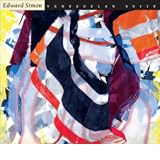
Product DetailsFinally, there is Edward Simon "Venezuelan Suite" (Sunnyside 2014) which excels as it extends the reach of Simon's music from his previous outings. This a new direction for the accomplished pianist who as a leader and as a member of the SFJazz Collective has already had a long string of excellent CDs demonstrating both his facility at the keyboard and his excellence in composition. While the first two recordings above combined jazz and classical music, this CD combines jazz with the rhythms and sounds of Simon's native country, and does so with a larger band with richer tonalities and timbres. Joining Simon are saxophonist Mark Turner,  John Ellis on bass clarinet, drummer Adam Cruz,  Roberto Koch on bass, Marco Granados on flute, Leonardo Granados on maracas, percussionist Luis Quintero and Jorge Glem on cuatro, the string instrument that is Venezuela’s national instrument.  Edmar Castaneda guests on one track on harp. The suite is composed of four tunes named after Venezuelan cities -- Barinas, Caracas, Merida, and Maracaibo; the final piece is "El Diablo Suelto" written by Heraclio Fernandez in 1888 and updated for this performance. The music is expansive, with a range of solos and ensemble sections, catchy beats, lilting melodies, and rich harmonies. The flute and cuatro in particular lend the music a special vibe that enriches the entire program. And Ellis' bass clarinet stands out on "Caracas". It's an enchanting set, a feast for the ears with it variety and pacing, and with the richness of the melodies and interplay among the many voices. Outstanding.

Thursday, April 11, 2013

Three Masterful Solo Pianists

I spent a while in the car Tuesday going from Connecticut to New Jersey for meetings -- non-rush hour the trip was about 75 minutes, coming home at rush hour it was about three hours. So I got to listen extensively to three CDs that I wanted to write about. As I listened, these CDs provoked me to think about what is jazz and what is modern classical piano. Was I listening to John Medeski or Eric Satie, Vladimir Neselovskyi or Claude Debussy; John Taylor or Franz Liszt? Is this music jazz? In fact, what is jazz in the context of these and many other similar CDs?

I am not going to try to decide what is or isn't jazz. It doesn't matter -- all that does frankly is that I like each one. Let others decide categories. What is important to me is conveying what these three piano recitals sounded like to me, to give enough of a feel so that readers might want to experience one or more themselves.

And all three are beauties.

So how do they feel? Well, at the end of 2012 I defined my favorites for the year into a set of categories, and these three CDs fall across two of them: Modern Lyrical Jazz (my interpretaton represented by the dancers) and Modern Impresssionistic Jazz (interpretation pictured as the seascape).  The distinguishing feature of the former is that modern lyrical jazz uses melodies as a point of departure more so than the modern impressionistic jazz, which does not necessarily begin with a distinctive melody but rather a mood.  In the first group I hear longer melody lines and tuneful harmonies;  the music flows, the lines are rounded and the constancy of movement is strong.  Modern impressionistic jazz to me is characterized by the creation of an atmosphere using sound and dynamics rather than melodies as the organizing principle, with rounded tones that envelope one in a comfortable place, with movements that are subtle and flowing, and with lots of open space. Mood and color trump melody and flow, and the dynamic range is minimized.

InsightJohn Taylor "Insight" (Sketch 2003) is not a new CD but it is new to me. I found it rummaging through old CD bins recently and being a big fan I picked it up immediately. Taylor is British, and while he is very well-known in the U.K. I am not sure how widely known he is in the U.S., although he should be. His solo CDs are marvelous, his recordings with Kenny Wheeler and Norma Winstone as Azimuth are fantastic, and he has a number of outstanding trio recordings on CamJazz and ECM. He was born in 1942 and is a self-taught pianist who established himself in the UK by the end of the 1960s.  He has been heard with other U.K. stars such as John Surman, Alan Skidmore, Cleo Laine and John Dankworth, and as noted above began working in groups with Kenny Wheeler and others in the 1970s. The work with Surman, Jan Gabarek and Wheeler, among others, are part of his repertoire with ECM. In 1977, with Wheeler and Winstone, Taylor formed Azimuth.  He is well known for his rich and lyrical play and is an accomplished composer as well. His trios include either Marc Johnson and Joey Baron, or Palle Danielsson and Martin France. "Insight" is Modern Lyrical Jazz as defined above. It is a solo recording full of rich melodies and improvisiations, wonderful harmonies and a range of dynamics and tempos. Taylor fills his songs with stunning melodies and strong left hand movements so that his tunes sound orchestral at times. Lush would be the word that comes to mind for the pieces, eight by Taylor himself and one each from Steve Swallow, Diana Taylor, and Kenny Wheeler. Each is impeccable and stylish, none stands out so all stand out. This is for those who love Jarrett, Pierranunzi, Steve Kuhn and others of that ilk.


Product DetailsVladimir Neselovskyi "Tunes for Today" (Sunnyside 2013) is a newcomer and his debut CD is a striking recording that covers some jazz classics, some classical repertoire, and some compositions by Neselovskyi himself. He definitely smears that line between jazz and classical as he covers both genres with passion and originality. His music fits into the Modern Lyrical Jazz category as well,  but begins to move towards freer impressionism as he deconstructs melodies into striking patterns and sublime colorings. He has worked in Gary Burton's band for some time and this is his first outing as a leader, and it is a dynamic piece of creativity and vision. It starts with his own "Spring Song" and bell-like play from the uppermost keys of the piano. What follows is a spritely piece, as much classical sounding as it is jazz. Neselovskyi's touch is immediately apparent -- quick runs with a light touch, followed by more dynamic legato lines and chords, all blended into a fascinating demonstration of both his compositional and playing skills. As the piece develops its drama increases, the dynamics grow, the speed intensifies, but the control is always there and connection made to the rest of the music before and after. When he moves into the next track, Chopin's "Mazurka op. 67 no.4" , it is striking how similar the music is to the opener, as I said blurring the line between jazz and clasical music. Neselovskyi clearly knows the repetoire and plays the piece straight at first, gradually moving into his impressions and improvisations seamlessly. Next up is the standards repetroire with "All the Things You Are", a chance to really see how creative the mind of the pianist can be. He picks out the tune over a rolling left hand to open the peice, but as it goes on the melody becomes more and more broken up and gradually it disappears into a lovely set of improvisations over a continuous left hand of quarter notes. The piece picks up intensity and volume as it moves onward, reaching some really intricate and large lines with more drama, until it resolves once again at the end. The pattern continues as he moves right ahead into the classical repetoire, this time an expansion of Bach's "Sinfonia No. 11 in G Minor BWV 797" which is the equal of those pieces that have come before and will come after. Two other pieces were written by Neselovskyi, one by Freddie Hubbard, and one by Tchaikovsky; and there are two more standards "My Romance" and "Body and Soul." "Body and Soul" begins with the melody in the left hand, with a bit of reformation to involve some minor chords, but by and large it is recognizable. Gradually the improvisations take over and the melody is almost entirely subsumed into the improvisations, popping up here and there in short bursts. It's a bravura use of the song to create something entirely knew and wonderfully creative. He does similar things to "My Romance" that are breathtaking to hear. The only mis-step to me is when he sings on Track 9, his own lyrics over Tchaikovsky's  "Andantino in modo de canzona." Even with that one hitch, this is one of the best CDs I have heard to date in 2013. By the way, it was produced by Fred Hersch, which says something about the quality of Neselovskyi in the eyes of one of the best pianists of our time.

Product DetailsJohn Medeski's "Past Time" (Okeh 2013) is notable for many reasons. First, it is the premiere recording on the restored Okeh label. Second, this is an amazing departure from his work with Medeski, Martin and Wood, even their accoustic works. And third because it is a very simple yet lovely meditation composed of 11 very quiet fully improvised miniatures that truly capture the essence of what Medeski himself states in the notes to the recording:

I only hope that this recording can be listened to late in the night, when social responsibilities are over, when the political questions of the day have been dealt with, when all the gossip has come to an end, when all the needs and wants have been put to momentary rest, when all plans have been made, when you are tired of words, and you are ready to yield to the sounds of these simple contemplations for the Gaveau [The piano manufacturer].

This is music for those who like quiet, slowly evolving tunes, and simplicity. This is Modern Impressionistic Jazz.  It has a unified air and a very limited, quiet dynamic range. Medeski uses very few large chords and many more single note melody lines, along with a very delicate touch. The first piece, "A Different Time" is played very slowly with a simple tune picked out one note at a time in the right hand while a very quiet  left plays a simple pair of notes underneath. Pensive, with lots of space, its delicacy is arresting as it fades to black. "I'm Falling in Love Again", one of only two covers (this one by Willie Nelson), comes next and is a bit more spritely with its simple melody picked out in the higher registers with simple chords played underneath; it is much like the sound of a music box, delicate and peaceful to the ear. The next piece, "His Eye is on the Sparrow" has a richer sound, more keys being played in the melody, more legato lines and more use of the pedal to extend the sounds. And yet it is still played slowly and at the same quiet dynamic level, particularly as it settles in. "Ran" introduces dissonance for the first (and only) time using chord clusters up front with spaces in between them. This is much more abstract than the rest of the pieces and somewhat jarring in context,  but it is only two minutes in length. It is followed immediately by a return to the music box qualities of earlier pieces with "Graveyard Fields", which has a lovely cascading melody at times and a simple single note melody at other times with a steady, very low rumbling bass in the left hand. And so it goes through four more meditations -- all very quiet and deliberate, all slowly rolled out and quietly played, and all quite lovely.  

Tuesday, May 29, 2012

Two Piano Trios Tackle Italian Film Music

Two piano trios, two Italian film composers, and two beautiful discs from CamJazz. That is the message for today.

Product DetailsJohn Taylor, the verteran British pianist with a long and distinguished discography, has released " "Giulia's Thursdays" (CamJazz 2012), a jazz tribute to the music of Carlo Rustichelli which is as elegant agraceful as any of his previous piano trios, particulalry those with Palle Danielsson on bass, and Martin France on drums, who round out the trio on this CD. Recorded in 2006 but held until now, this is beautifully melodic and inspired music from a composer who is very little known outside Europe, unlike Nino Rota, for example, who has had two tribute discs released of his music this year by Mark Soskin and Richard Galliano. Rustichelli's two selections from his most famous score "Divorce Italian Style" are both lilting melodies, but then so are most of the pieces which have a refined and somewhat subdued sensibility, which in turn brings out those moments which rise above mezzo-forte or which romp at speeds beyuond the mostly mid-tempo themes that dominate. This is another beautiful disc in the vein of much of Taylor's previous works and recommended.

Product DetailsEdward Simon, is a 42 year old Venezuelan pianist and recent (2010) recipient of a Guggenhiem Fellowship, and has a long list of recognized recordings, including two -- Edward Simon (Kokopelli Records 1995) and Simplicitas (CamJazz 2005) -- which were on many top ten lists for those years -- and his recent recordings as a member of the SFJazz Collective. His piano trios combine straight ahead jazz with the rhythms and feel of his South America roots, and a personal reflections for Simon of is heritage and jazz education. On this newest  release, also held since recorded in 2006, "A Master's Diary" (CamJazz 2006), he and his trio with Scott Colley bass and Clarence Penn on drums tackle the musical scores of Fiorenzo Carpi, who wrote for Italian theatre, and television. The trio, joined on the opening number by the muted trumpet of Diego Urcola, have taken the lyrical melodies and added their own touch based on the heritage of Simon and the jazz sensibilities of the trio. the music is light and elegant, with long passages of wonderfully solid trio play that, according to the liner notes, rewrite and elevate the music to new heights.

Two refined and elegant tributes for piano trio lovers.

Wednesday, March 28, 2012

Listening to: Kenny Wheeler "Music for Large and Small Ensembles" (1990)

Music for Large & Small EnsemblesJust a quick entry today. In preparation for the new Kenny Wheeler Big Band disc coming soon on CamJazz, I went back to the collection and am listening to "Music for Large and Small Ensembles" (ECM 1990) which may be a forgotten gem given that since that time Wheeler has largely been seen in small chamber-like settings. This two-CD set, however, shows another side to Wheeler, a more robust sound, more mid-tempo play, and incredible compositional work. Furthermore, the ensemble itself is a roster of first rate players, many still on the scene today and recognized as hall-of-fame category stars; and many of whom will be appering on his new big band disc as well.

Wheeler employs the big band to display the best qualities of his writing, which is always subtly nuanced and colored by the use of unusual combinations of sounds among his players. This big band is not a big band in the sense of the traditional big bands of the previous era or the ghost bands of the 90s, but rather is a sould mate to the sounds produced by Gil Evans and a precursor to the sounds of a Maria Schneider band. Ensemble play at times, small group play at others, and senesitivity between partners characterizes the sounds herein. Inherently emotional, beautifully colored by sensitive players, and highly melodic, it is no surprise to know it is considered part of a core collection by the Penguin Guide to Jazz.

And the roster! Besides Wheeler on trumpet and fluegelhorn, there is John Abercrombie on guitar, John Taylor on piano, Dave Holland on bass, Peter Erskine on drums, and Norma Winstone voice. Any one of these players has a list a mile long of five star CDs, with Taylor and Winstone being my particular favorites (Taylor will shortly have his own new piano trio out on CamJazz as well called "Giulias Thursdays". I have written previously on Norma Winstone for this blog.)

And within the other  sections (trumpets, trombones, saxophones) I want to highlight Evan Parker, Julian Arguelles, and Stan Sulzman, each also a well-known leader with an extensive discography.

This is an outstanding album for fans of Wheeler, or large ensembles, melody, and beauty; and for those who do not know many of this British players, a chance to be iintroduced to open a door on a wealth of new music to listen to.

Saturday, January 7, 2012

Overlooked: Norma Winstone


Norma Winstone, who has been called England’s finest jazz vocalist, was born in 1941 and has been recording since the early 1980s, as a leader since   
" Somewhere Called Home" on ECM in 1987. Yet she never hit my radar until two individuals gave me a nudge in her direction. So thank you Steve Katai, for all our converations at Sally's and for pointing me to " Stories Yet to Tell". And thanks, too, to Christine Allen of Basho Records for not only reading my blog, but for directing me to Norma Winstone based on my 2011 favorites list. And thanks to Sally White of Sally's Place (Westport, CT) for stocking ""Stories Yet to Tell", "Distances" and Somewhere Called Home." Having a shop like Sally's Place that actually stocks a huge jazz collection is a treasure.

I called this entry "Norma Winstone: Overlooked" simply because I have overlooked her in my meanderings through the jazz world. But then again, I think most folks in the U.S. have probably missed her as well. Granted, vocalists are not at the top of my must hear list, but as my end of 2011 list showed I clearly do listen to them, and in some cases love what I hear. So why did I pass her by time and time again when I clearly had seen her CDs at my local store, and why did I instead try others first? I think there are three reasons:
  • She is hardly publicized in the U.S., is not from the U.S., and doesn't perform here that much.
  • When there is a new disc with attendant publicity and/or reviews, the music is on ECM, which has a cache that does not lend itself to assuming that a singer will be as "straight'ahead" as Winstone.
  • There are a lot of singers who do get press, publicity, and radio airplay in the U.S., and she is not one of them. Folks this past year were much more likely to have heard of Gretchen Parlato, Tierney Sutton, or Karyn Allison, each of whom had a hit album in 2011. That leaves little room in the market to find Norma Winstone.
After listening three of her discs, I am now a huge Norma Winstone fan. Her voice is wonderfully expressive and never overstated or over-wrought, her lyrics have deepened over time, and her interplay with her accompanists is outstanding. Her voice is lovely and soothing to hear and she tells wonderful stories. At times to me her voice was reminiscient of a restrained Barbara Streisand singing a ballad; others have compared her sound to Helen Merrill. This is reflective music, to be taken in and savored.

On the first of the three discs, "Somewhere Called Home" (1987) she is joined by John Taylor on piano, and Tony Coe on clarinet and tenor saxophone. The sound is almost pastoral, as Winstone takes most of the songs at a lovely mid-tempo pace, and the accompanists provide touches of color suitable to the lyrics. Winstone added lyrics to beautiful melodies of some great players -- Egberto Gismonti, Ralph Towner and Kenny Wheeler -- enrichening them and transforming them into a new standard for jazz singers to reach.  Her two standards, Arlen and Mercer's  "Out of This World" and Vincent Youmans' "Tea for Two," are voiced delicately with subtle undertones from her supporting players. Until now I had never heard the latter done as a slow ballad, which really concentrates the listener on the lyrics, and changes what most think of as a simple ditty into a truly lyrical, beautiful ballad. The tenor interlude by Tony Coe is incredibly rich and adds to the overwhelming sentiment behind the song.   Winstone is a wonderful and original interpreter, and her bandmates evince an equally tempered sentiment. There are no vocal gymastics, no great swells and troughs, because none are needed to appreciate this wonderful music and hear each song's sentiment. 

The two later discs are equally wonderful, if not deeper in tone and emotion. Her supporting players, feature the bass clarinet played by Klaus Gesing (along with some soprano sax), and the playing of Glauco Venier on piano, with whom Winstone has a long-standing trio dating back some 10 years.  
Cover (Distances:Norma Winstone) "Distances" (2008) features a wide range of songs  from Cole Porter to Peter Gabriel, a free calypso, a tribute to Coltrane, adaptations of Satie, folk songs, Pasolini and more, all of which flow seamlessly as an extended suite. Winstone’s lyrics are rich with imagery and the sentiments of a older and wiser woman. Words like poignant and lyrical come to mind in describing the set. There is regret in "Here Comes the Flood", irony is "A Song for England", and melancholy in the title song "Distances."  The piano and bass clarinet in A Song for England are especially fun and suited to the song, which begins with two minutes of wordless singing by Winstone followed by some fun lyrics and a calypso beat. Winstone is a wonderful interpreter of the lyrics, and again the music of Vernier and Gesing add just the right touches to each song. From start to finish, this is a truly compelling recording.

Stories Yet to Tell"Stories Yet to Tell" (2010) is Winstone's most recent disc. Winstone the lyricist contributes to eight of its twelve songs. It is clearly the most personal collection to date, and as bewitching as all that came before.  Her  partnership with Venier and Gesing is more fully realized, and the two provide a great deal of support both in the compositions and in their delivery in backing the full richness of Winstone's soft, beautifully realized lyrics. Three of the four songs are instrumentals arranged by Venier, wherein Winstone provides some wordless singing to produce a fully realized trio. When she does sing, her interpretations are once again at the forefront and her lovely, rich, full alto overwhelms the listeners senses with consummate beauty. 

Sorry I missed you Norma. I look forward to hearing more from your discography, and to future releases.