There is no flash here, just a piano trio playing really nice music that is largely impressionistic and tinged with a northern european sensibility -- lyrical, creative, mellow music which is just right for those who like modern creative piano trios, or, like me, love all things Italian.
Showing posts with label Roberto Gatto. Show all posts
Wednesday, November 21, 2012
This Just In! Roberto Gatto's Latest
There is no flash here, just a piano trio playing really nice music that is largely impressionistic and tinged with a northern european sensibility -- lyrical, creative, mellow music which is just right for those who like modern creative piano trios, or, like me, love all things Italian.
Monday, October 8, 2012
Italian Jazz: Roberto Gatto, The Man Behind the Kit
Rea, Sellani, Basso, Pieranunzi...the first four of my Italian series was begun during the summer, and has been on hiatus for quite a while.
Today, I am picking it up again with drummer extraordinaire Roberto Gatto, clearly the go to drummer for much of the past three decades among Italian jazz players. Gatto has an exhaustive list of leader discs, but even a greater number of CDs as the beat behind those great names listed above as well as many others. One clear reason for his position in the pantheon of drummers is his great flexibility -- he can get out in front and drive a band with the best of them, he can drop bombs when needed or back off and provide quiet but insistent support, or he can be a colorist playing whispering brushes and gentle sticks. He is adaptable to a range of music, as will be seen in the discography presented here, and he writes great tunes, be they lyrical romantic themes, jaunty swing songs, or simple modern creative jazz. I've yet to come across a disc with Gatto playing hat I have not enjoyed, whether as the leader or as a member of some awesome groups.
Roberto Gatto is one interesting and original drummer and composer. A list of his collaborators is a who's who of jazz: as a sideman, he has played with Dave Liebman, Phil Woods, James Moody, Barney Wilen, Ronnie Cuber, Michael Brecker, Joe Lovano, Curtis Fuller, Cedar Walton, Tommy Flanagan, John Scofield, John Abercrombie, Bobby Hutcherson, Joe Zawinul, and Pat Metheny. As a leader he has recorded fifteen albums with many of the first names in Italian jazz: Enrico Pieranunzi, Franco D'Andrea, Stefano Bollani, Enrico Rava, Paolo Fresu, Rosario Giuliani, Gabriele Mirabassi among others.
Of the 15 as leader, his first, which I do not have, was made in 1986 with Michael Brecker, "Note" (Gala 1986). Heck of a way to start a recoding career. Of the remaining fourteen, I have seven.
That next CD is "The Music Next Door" (Emarcy 2009) and it is killer, with Tittarelli again on the saxes, Rosario Bonaccorso on bass, and two of the biggest shining stars in Italian jazz, Stefano Bollani on piano and Paolo Fresu on trumpet. The quintet clearly demonstrates the highest degree of musicianship possible. From their long relationships from many other ensembles and records, they also demonstrate their abilities to hear and complement each other, and demonstrate outstanding ensemble play. The music is a bit livelier than "Traps", with Gatto's six originals more upbeat, giving him a greater opportunity to lead from the back. The group plays in the great tradition of quintets like this, with opening statements of the tunes followed by each player taking a turn on solos before a return to ensemble play. The tunes themselves are nicely composed, the harmonics easy on the ear and tuneful -- this is modern creative jazz with its legacy clearly steeped in tradition. Gatto is omnipresent setting the pace, coloring the tunes, or pushing the beat, but is never in your face -- he is never bombastic, and doens't need to prove his mettle by being out front. A great turn for everyone and terrific play by Fresu and Pieranunzi make this a must listen if you want to hear Gatto's conceptions at their best.
As noted above, Gatto clearly is part of the great tradition of drummers dating back into the 50s and 60s, and he demonstrates his debt to one of them with two tribute discs, "Remembering Shelly" (Albore Jazz 2009) and "Remembering Shelly 2" (Albore Jazz 2010). Again using a "standard" quintet reflective of the groups of Shelly Manne, he has Giuseppe Bassi on bass, Luca Mannutza on piano, Max Ionata on sax, and Macro Tamburini on trumpet.
These are live recordings played at the same sessions, and include several songs that were from Manne's "book" along with a couple of Gatto orginals done in the same vein. These are two wonderfully upbeat, swinging bop discs, with Gatto's steady hand given full rein to play in the Manne/60s style. Strong leadership and timekeeping, steady high hat and bass drum set the tempo for terrific interpretations of "Nightingale", "Fan Tan", and Speak Low" for example could have been right out of the days of Shelly's Manne Hole, with unison play as well as solos by the trumpet and sax. This is A-One hard bop in a live setting, which adds to the electricity that can be felt throughout. Two great tributes that are not slavish to the past, but rather terrific interpretations thereof.
Finally, I cannot leave Gatto without noting that he has over 50 recordings as a side man as a contributor to many other fine CDs. Of note from my collection, I would list these:
Enrico Pieranunzi "Jazz Roads" (CAM Jazz 1980)
- Tommaso, Rava Quartet "La Dolce Vita" (CAM Jazz 2000)
- Phil Woods "Embraceble You" (Philology 1988)
- Rava, Fresu Quintet "Shades of Chet" (Via Veneto 1999)
- Rava "The Words and the Days" (ECM 2005)
- Bollani and Gatto, "Gershwin and More Live" (Philology 2006)
Friday, July 27, 2012
A Younger Generation Pianist in Italy: Danilo Rea and Doctors 3
As should be clear from previous posts, there is a coterie of Italian jazz musicians that not only lead their own bands but also work collectively together in a variety of places and settings. Pieranunzi, Basso, and Sellani are three of the grand masters, and each not only has played music with many others but each has also mentored the next generation.
This post brings to the fore one of the younger, but no less talented, pianists, Danilo Rea, whose name has already come up in conjunction with the CDs of the masters. Rea is a comparative youngster, born in Vincenza in 1957, educated at the Santa Cecilia Music Conservatory in Rome, debuting on record for the first time in 1975 with the Rome Trio of Roberto Gatto and Enzo Pietropaoli (two names for a later post)and debuting as a leader on record only in 2003. Since then, AllMusic lists him as leader on about a dozen CDs, as well as a supporting member of countless others. He is also a member of a wonderfully inventive trio, Doctors 3, which I will include in this post as well.
During his career, he has worked with Chet Baker, Lee Konitz, Phil Woods, Art Framer, Curtis Fuller and Kenny Wheeler among international stars. Running further down the list is like looking at the "Who's Who" of Italian Jazz: Paolo Fresu, Renato Sellani, Franco D'Andrea, Roberto Gatto, Enzo Petropaoli, Flavio Boltro, Aldo Romano, Giovanni Tomasso, and Pietro Tonolo are sprinkled throughout his discography. Finally, he is also sought after as a player of Italian pop music, and has played behind many Italian pop singers. His work with the piano trio Doctors 3 highlights that aspect of his play very well.
Rea is a player who is capable of performing across the broadest of musical categories, from classical music to jazz and pop music. As a young disciple of the masters and child of the 60s and 70s, Rea's influences extend across a wider range of music than Sellani and even Pieranunzi, although the latter certainly shows the same sparks of modernism and boldness at times that characterizes Rea's work. Rea is certainly more into the modern songbook, but still retains the same attention to melody and the harmonic sensibilities of his masters, never straying too far out of the box. His discography highlights the variety in his work, both in terms of his musical breadth as well as the settings -- solos, duos, trios, and a quintet are all a part of the collection I have of his music. These performances are done both in studio and live from the Umbria Jazz Festival, where Rea has bcome one of the featured performers in each format and with Doctors 3.
His CDs as leader demonstrate that Rea has a number of personalities that he brings to the music.
"Improvvisi" (Duck Record 2002) is a duo recording with drummer Robert Gatto, a major name in Italy as well. My Italian is not so good, but the liner notes basically say that in the past year the two friends decided upon a collaboration, and to do an ambitious program -- eliminating any pre-ordained playlist and in fact no songs at all unless they came to them spontaneously. They would create from the air the melodies, rhythms, and harmonies. They would be guided by their backgrounds, culture, and communal language. They would let the sounds guide them, and when they were done, they hoped to have a recording worth hearing. And they succeeded and the results speak for themselves, 13 pieces, 11 originals and two others, of varying tempos -- with a common bond of two players who clearly are in touch with each other. Jazz and classical music merges here in the originals, one of which is dedicated to Debussy, and in a lovely rendition of the Moldau by Smetana. Brilliant showmanship.
"Romantica" (Venus Records 2004) is a piano trio, with Ares Tavolazzi on bass and Gatto again on drums. My Italian might be bad, but I cannot read Japanese at all, so the liner notes are useless. But the music is magnifico -- here we have jazz interpretations of what I believe are Italian favorites, of whom I only recognize Ennio Morricone's name. What I do know is that the melodies are all as romantic as advertised in the title, Rea brings to each his full bag of expressive chords, runs, and range of dynamics. Gatto keeps the tempo, adds color, and introduces several of the tunes with the snare and cymbals, that then underlie the melodies. On "Munastero 'E Santa Clara" plays a bongo-like rhythm that adds sparkle to the tune, the second on the disc, and on Tu Si' Na Cosa Grande he maintains a latin beat for Rea's lilting tune. These sound like the "Great Italian Songbook" as sung by Sergio Franchi, Mario Lanza, and others.
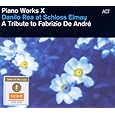
"Piano Works X, Danilo Rea at Schloss Elmau: A Tribute to Fabrizio De Andre" (ACT 2010) is a solo recording in a settting that has seen a number of solo piano artists come before. Fabrizio De Andre was an Italian singer-songwriter who died prematurely in 1999, well-known in his homeland for his challenging songs and their subjects, often those who were most in need of aid. Rea has taken this powerful body of work and to it has applied his ample creative powers, as the notes say to create "...classical stud[ies] to chromatically dazzling ballads and from swinging syncopated blues to free jazz impressions." The music overflows with Rea's brilliance, expressive play, and melodic sensibilities once again. Easy to find and well-worth the effort to do so.
Rea returned to Schloss Elmau in 2011 with the trumpet player Flavio Boltro (see yesterday's post on Boltro) for "Opera". In such a brilliant accoustical setting, the sounds from Boltro's trumpet and Rea's Steinway are bell-like, clear and beautifully balanced, as the two cover 12 pieces of Monteverdi, Rossini, Bellini, Giordani, Vivaldi, Puccini, and Cilea, in their own very creative and clearly jazz-tinged way. The passions of the two classically trained players were made for this music, and the drama of the opera is transmuted to their golden sounds and to the improvisations. High drama, big emotions, all of the best characteristics of the opera are here, with a jazz twist, and played through a great range of dynamics to tell their stories. The piece most of us are most familiar with, the "William Tell Overture" concludes the CD and the twists are most evident to the non-opera listener, and very enjoyable as well. It is nothing you have ever heard --some blues, some boogie woogie -- I am sure many opera lovers would have their ears covered early and often. But not the jazz fans.
In 1999, the first one I have is "The Songs Remain the Same" (Via Veneto Jazz 1999), clearly a reference to Led Zeppelin, and the songs are a mix of pop/rock, standards, and traditional music. Six of the 11 pieces are composites of multiple songs, and the first starts the listener off in a traditional vein, with "Danny Boy" and "Bye Bye Blackbird." From there we have mixes like "A Salty Dog" with Charlie Parker's "Buzzy", "Stairway to Heaven" with "Cam Camini", and "Stella By Starlight" with two lovely melodies by the group and by Domenico Modugno. If this sounds a bit weird it is not; in fact the blends are done seamlessly, and the jazz improvistations polish each piece to a gem-like appeal. U2, Emerson Lake and Palmer, and Peter Gabriel all make an appearance as well on this wonderful set.
In 1999 the group referenced Led Zeppelin in the title; in 2001 they reference themselves. The disc is "Bambini Forever" (Via Veneto Jazz 2001) and expresses wonderfully the child-like fun the group has when they mash the music together. Ten sets this time with only two Lennon and McCartney songs -- "Here There and Everywhere" and "She's Leaving Home" -- not being mash-ups. The rest are three or four song suites, and the range of composers include the Red Hot Chili Peppers, Wayne Shorter, Hammerstein and Kern, Pat Metheny, and Sting; along with several group originals and a set dedicated to Fabrizio De Andre. This is another hit that demonstrates that the jazz songbook can be open to much more than the Great American Standards, and demonstrates exactly how three creative musicians can turn rock into real, believable and enjoyable jazz.
For "Jazz Italiano Live 2007: Doctor 3" (Azienda Speciale Palaexpo 2007) the group dedicated itself to two composers in a single, unified set of 13 memorable songs that almost everyone knows. The composers are Lennon and McCartney, and the set is a jazz version of "Sargent Pepper's Lonely Hearts Club Band." Jazz traditionalists and purists might scoff at the set, but there is nothing but imagination (no pun intended), free play, and joy in the set. Clearly the trio is enjoying themselves, and the feeling transmits itself to the live audience and over the speakers to those of us hearing it on disc. This is a toe-tapping tour de force for the trio.
In 2008, the trio came back to Umbria once more, and almost one-upped its last performance, on ""Jazz Italiano Live 2008: Doctor 3"(Azienda Speciale Palaexpo 2008), with several more rock hits in a jazz mood, with a few other songs from De Andre and others as well. This time the set varied among the rock composers -- Fred Neil's "Everybody's Talkin' At Me", Ragni and Rado"s "Aquarius/Let the Sunshine In" from Hair, Jagger and Richards' "Jumpin' Jack Flash", Paul Simon's "Sound of Silence" and "Mrs. Robinson -- included some pop by Bert Bacharach and Hal David "This Guy's in Love With You" and some soul by Otis Redding ("Sittin' on the Dock of the Bay"). But my personal favorite is the traditional "John Barleycorn Must Die" (done by Traffic) with "Steve Winwood's "Glad".
Doctors 3 must have been created to bring a smile to everyone's faces, and does everytime out. Rea's humor, shown periodically in his works as a leader outside the group, blossoms with this group, and a good time is had by all.
This post brings to the fore one of the younger, but no less talented, pianists, Danilo Rea, whose name has already come up in conjunction with the CDs of the masters. Rea is a comparative youngster, born in Vincenza in 1957, educated at the Santa Cecilia Music Conservatory in Rome, debuting on record for the first time in 1975 with the Rome Trio of Roberto Gatto and Enzo Pietropaoli (two names for a later post)and debuting as a leader on record only in 2003. Since then, AllMusic lists him as leader on about a dozen CDs, as well as a supporting member of countless others. He is also a member of a wonderfully inventive trio, Doctors 3, which I will include in this post as well.
Rea is a player who is capable of performing across the broadest of musical categories, from classical music to jazz and pop music. As a young disciple of the masters and child of the 60s and 70s, Rea's influences extend across a wider range of music than Sellani and even Pieranunzi, although the latter certainly shows the same sparks of modernism and boldness at times that characterizes Rea's work. Rea is certainly more into the modern songbook, but still retains the same attention to melody and the harmonic sensibilities of his masters, never straying too far out of the box. His discography highlights the variety in his work, both in terms of his musical breadth as well as the settings -- solos, duos, trios, and a quintet are all a part of the collection I have of his music. These performances are done both in studio and live from the Umbria Jazz Festival, where Rea has bcome one of the featured performers in each format and with Doctors 3.
His CDs as leader demonstrate that Rea has a number of personalities that he brings to the music.
"Lost in Europe" (Via Veneto Jazz 2000) has one of my favorite whimsical covers, and documents music from a solo piano tour of Europe in the summer of that year. The range of the music is broad and the perfomrances are full of life, expression, and wit. Two pieces were penned by Rea, and several of the pieces are actually mini-suites. To understand the variety in Rea's repetoire, take the seventh piece on the disc, an amalgam of one show tune, "America", one classical piece, "Pour le Piano" by Debussy, one song by Rea, and one Italian song "Un Gioro Dopo L'Altro," and watch them unfold seamlessly and effortlessly. "Tico Tico" is magnificently expressive, rapidly paced, with a hidden surprise; "Sospensione so expresssive and with an ending so passionate it could make you cry. Another suite links the following -- "What a Wonderful World", Time After Time", "La Danza", and "Mr. P.C." The music is incredible, the imagination tremendous, and the playing bold.
"Improvvisi" (Duck Record 2002) is a duo recording with drummer Robert Gatto, a major name in Italy as well. My Italian is not so good, but the liner notes basically say that in the past year the two friends decided upon a collaboration, and to do an ambitious program -- eliminating any pre-ordained playlist and in fact no songs at all unless they came to them spontaneously. They would create from the air the melodies, rhythms, and harmonies. They would be guided by their backgrounds, culture, and communal language. They would let the sounds guide them, and when they were done, they hoped to have a recording worth hearing. And they succeeded and the results speak for themselves, 13 pieces, 11 originals and two others, of varying tempos -- with a common bond of two players who clearly are in touch with each other. Jazz and classical music merges here in the originals, one of which is dedicated to Debussy, and in a lovely rendition of the Moldau by Smetana. Brilliant showmanship.
"Romantica" (Venus Records 2004) is a piano trio, with Ares Tavolazzi on bass and Gatto again on drums. My Italian might be bad, but I cannot read Japanese at all, so the liner notes are useless. But the music is magnifico -- here we have jazz interpretations of what I believe are Italian favorites, of whom I only recognize Ennio Morricone's name. What I do know is that the melodies are all as romantic as advertised in the title, Rea brings to each his full bag of expressive chords, runs, and range of dynamics. Gatto keeps the tempo, adds color, and introduces several of the tunes with the snare and cymbals, that then underlie the melodies. On "Munastero 'E Santa Clara" plays a bongo-like rhythm that adds sparkle to the tune, the second on the disc, and on Tu Si' Na Cosa Grande he maintains a latin beat for Rea's lilting tune. These sound like the "Great Italian Songbook" as sung by Sergio Franchi, Mario Lanza, and others.
As I said before, Rea is loved throughout Italy and particularly at the Umbria Jazz Festivals each Jazz Italiano Live used to put out annual recordings from the festival of its major stars, and I have those from 2006 and 2009 by Rea: "Jazz Italiano Live 2006: Danilo Rea" "Jazz Italiano Live 2009: Danilo Rea" (Azienda Speciale Palaexpo 2006 and 2009). The 2006 disc is a quintet with Marcello Sirignano on violin, Pietro Tonolo on saxes, Giovanni Tommaso on bass, and Massimo Manzi on drums. It is 14 pieces all written by Rea and played nicely by the group, with the crowd clearly enjoying the music, the plyaers, and the energy that readiates from all of it. In 2009, REa played with a trio, inclduing Enzo Pietropaoli on bass and Roberto Gatto on drums, an 11 piece outing that again features all original songs and the ususal high standards expected of the three players.
So who is Danilo Rea? He is a perfomer of astonishing solo concerts based on opera, an improvisor who does concerts in the manner of Keith Jarrett, a lover of the great standards from his country and the U.S., and a nodernist who enjoys the pop music of the 60s, 70s and later. He is bold ands creative, expressive and romantic, and a composer of beautiful tunes. He is lively on stage and in performance on disc, humerous in his choices, and a true entertainer, not unlike another pianist from Italy, Stefano Bollani (who will have his day here as well).
And now onto Rea's other musical identity, that of the pianist in Doctor 3, a trio with Enzo Pietropaoli on bass and Fabrizio Sferra on drums. This is one heck of a fun group, seemingly dedicated to having fun playing largely the music of their youth and mine from the 60s and 70s, interspersed here and there with the Great American Songbook. The music is simply fun and the group projects that in the studio and particularly in live performances at the Umbria Jazz Festivals. Each player is a master of his instrument, and of the repetoire, so the musical expression comes easily and creatively from each. They seem to have 6 CDs in print, of which I have four, as follows:
For "Jazz Italiano Live 2007: Doctor 3" (Azienda Speciale Palaexpo 2007) the group dedicated itself to two composers in a single, unified set of 13 memorable songs that almost everyone knows. The composers are Lennon and McCartney, and the set is a jazz version of "Sargent Pepper's Lonely Hearts Club Band." Jazz traditionalists and purists might scoff at the set, but there is nothing but imagination (no pun intended), free play, and joy in the set. Clearly the trio is enjoying themselves, and the feeling transmits itself to the live audience and over the speakers to those of us hearing it on disc. This is a toe-tapping tour de force for the trio.
In 2008, the trio came back to Umbria once more, and almost one-upped its last performance, on ""Jazz Italiano Live 2008: Doctor 3"(Azienda Speciale Palaexpo 2008), with several more rock hits in a jazz mood, with a few other songs from De Andre and others as well. This time the set varied among the rock composers -- Fred Neil's "Everybody's Talkin' At Me", Ragni and Rado"s "Aquarius/Let the Sunshine In" from Hair, Jagger and Richards' "Jumpin' Jack Flash", Paul Simon's "Sound of Silence" and "Mrs. Robinson -- included some pop by Bert Bacharach and Hal David "This Guy's in Love With You" and some soul by Otis Redding ("Sittin' on the Dock of the Bay"). But my personal favorite is the traditional "John Barleycorn Must Die" (done by Traffic) with "Steve Winwood's "Glad".
So that is Danilo Rea -- creative, expressive, and a master of many genres. His music is the equal of any pianist playing today, so pick one of his CDs up soon and give him a chance.
NOTE: This was post 100 on this blog. I wan't sure when I started I could get his far or had enough to say, but it turns out I have been enjoying the opportunity to write about something I truly love. I hope that those who are reading this feel the same about jazz, and maybe even about the blog. Thanks to all of you.
Friday, July 20, 2012
The Dean of Italian Pianists: Enrico Pieranunzi
I am totally hooked on Pieranunzi, and consider him to be my number one pianist. His works are tremendously varied, not only in the format/groupings, but also in the range of music from which he draws inspiration both as a player and as a composer. His music includes songs from the great jazz standards, Italian standards and folk music, movie scores from Rota and Morricone, the classical pieces of Scarlatti, Bach, and Handel, and tributes to Wayne Shorter and Bill Evans; alongside his own compositions and those of others writing jazz today. His interpretations range from the straight-forward to gorgeous flights of fancy as he interprets, energizes, and recreates the songs in his own vocabulary. He is a classicist at heart and student of that form, as well as a student of Evans and other post bop players. Never straying too far from the melody or basic harmonics, he nonetheless opens new horizons on any song he touches. He thinks large and plays large, not with a lot of single note runs but rather with lots of chordal voicings from both hands, as if he was composing for an orchestra and all of its voices.
Rather than trying to describe individual songs or CDs, I would sum up Pieranunzi's play with the following adjectives:
- Lyrical
- Expressive
- Prolific
- Creative
- Sensual
- Eloquent
- Fresh
- Energetic
- Captivating
Furthermore, it is often said that you are known (or judged) by the company you keep. So here is a list of the most common playing partners of Pieranunzi on his recordings, starting with the non-Italians:
- On bass, Marc Johnson, Charlie Haden, Hein Van de Geyn, John Patitucci
- On drums, Joey Baron and Paul Motian, Hans Van Oosterhout, Antonio Sanchez, Billy Higgins
- On piano, Bert van der Brink
- On trumpet, Kenny Wheeler, Chet Baker, Eric Vloeimans, Diego Urcola, Art Farmer (flugelhorn)
- On guitar, Philip Catherine, Jim Hall
And Italians galore. Among the best known:
- Roberto Gatto, drums
- Dado Moroni, piano
- Enzo Pietropaoli, bass
- Enrico Rava, trumpet
- Fabrizio Bosso, trumpet
- Rosario Guiliani, saxes
- Gabriel Mirabassi, clarinet
Hopefully, the above has established Pieranunzi's incredible credentials and perhaps a sense of his playing in your mind. With that in mind, here is the list of re3cordings that I have in my collection, coded as follows:
- Red writing means solo recording
- Blue writing means trio
- Black writing includes all other combinations
- ***** Five stars indicate the recordings that I might suggest today as the best places to start. By tomorrow, however, that could change. Basically any Pieranunzi is a good Pieranunzi. The best way to select for the first time probably is to decide on the grouping, and then on the mix between standards or other sources of the music. Or perhaps on the supporting players, Motian versus Baron, Haden versus Johson, etc.
In chronological order:
- "Jazz Roads" (CamJazz 1980), with Roberto Gatto, Marc Johnson, and Steve Houghton (d)
- "No Man's Land" (Soul Note 1990) with Marc Johnson and Steve Houghton
- ***** "The Night Gone By" (Alfa Music 1996) with Marc Johnson and Paul Motian
- "The Chant of Time" (Alfa Music 1997) with Marc Johnson and Joey Baron
- "Un'alba Dipinta Sui Muri" (Egea 1998) Solo
- ***** "Daedalus' Wings" (Challenge 1999) 2 pianos with Bert van den Brink
- "Don't Forget the Poet" (Challenge 1999) Quintet
- "Plays the Music of Wayne Shorter" (Challenge 2000) With Hein van de Geyn and Hans van Oosterhout
- "Improvised Forms for Trios" (Challenge 2000) Hein van de Geyn, Hans van Oosterhout
- "Evans Remembered" (VVJ Jazz 2001) Sextet includes Fabrizio Bosso and Gabriel Mirabassi
- ***** "Play Morricone" (CamJazz 2001) Marc Johnson and Joey Baron
- "Alone Together" (Challenge 2001) Quintet
- "One Lone Star" (YVP Music 2002) Quartet includes Roberto Gatto and Rosario Giuliani
- "Current Conditions" (CamJazz 2003) Marc Johnson and Joey Baron
- ***** "Transnoche" (Egea 2003) Duo, with Marc Johnson
- ***** "Fellini Jazz" (CamJazz 2004) Quartet with Chris Potter Charlie Haden and Paul Motian
- "Doorways" (CamJazz 2004) Paul Motian and Chris Potter****
- "Play Morricone 2" CamJazz 2004) Marc Johnson and Joey Baron
- ***** "Live in Paris" (Challenge 2005) Hein van de Geyn and Andre Ceccarelli (d)
"Special Encounter" (CamJazz 2005) Charlie Haden and Paul Motian
- ***** "Ballads" (CamJazz 2006) Marc Johnson and Joey Baron
- "Untold Story" (Egea 2006) Marc Johnson and Paul Motian
- "Jazz Italiano Live 2006" (Palaexpo 2006) Septet, live from Umbria Jazz Festival
- "Live in Japan" (CamJazz 2007) Marc Johnson and Joey Baron
- "Parisian Portraits" (Egea 2007) Solo
- "As Never Before" (CamJazz 2008) Marc Johnson, Joey Baron, and Kenny Wheeler
- ***** "Plays Domenico Scarlatti" (CamJazz 2008) Solo
- ***** "Yellow and Blue Suites" (Challenge 2008) Duo with Marc Johnson
- "Seaward" (Soul Note 2009) Hein van de Geyn and Andre Ceccarelli
- "Dream Dance" (CamJazz 2009) Marc Johnson and Joey Baron
- "Live at Birdland" (CamJazz 2010) Latin Jazz Quintet
- "Wandering" (CamJazz 2010) Solo
"Plays Bach, Handel, and Scarlatti" (CamJazz 2011) Solo
- ***** "Permutation" (CamJazz 2012) Marc Johnson and Joey Baron
- "Chet Baker Meets the Space Jazz Trio" (Philology 1988) with Enzo Pietropaoli on bass and Fabrizio Sferra on drums.
- "Silence" (Soul Note 1989) Charlie Haden with Chet Baker, Enrico Peranunzi and Billy Higgins
- "Soft Journey" (Egea Historic Collection 2007 (recorded in 1979/80) Chet Baker and Enrico Pieranunzi with Maurizio Giammaco tenor sax, Riccardo DelFra, Bass and Roberto Gatto, drums
Thursday, July 19, 2012
Get to Know the Italians
I previously posted on jazz players from the U.K., and have also written individual reviews of a great many recordings from the U.K. Beginning with this post, I intend to do the same for the Italians, who are extremely well represnted in my collection. I love all things Italian. The food is delicious, the art magnificent, the wine glorious, the country beautiful, and the language resonant. Words like "Montepulciano" and "Cinque Terre" roll off the tongue, "Chianti" brings images of Tuscany, "Barbera d'Asti" of the Piedmont, and all of it brings images of platters of fine foods. Prosciutto and melone, cannoli, chianti, gnocchi...I could go on for a while like this.
Over the next several weeks or even months, I am going to spotlight the leaders who populate my collection of Italian jazz. To begin the effort I pulled from my shelves as many of my CDs as I could find. My collection is neither alphabetized nor in any other way highly organized (someday.....), and I expect that as of today I have forgotten somebody. If so, please send me a comment on who I may have missed in the list below.
Without further ado, and organized by instrument, I will be commenting on the following players:
- Enrico Pieranunzi (pictured on top right)
- Franco D'Andrea
- Renato Sellani (to the right)
- Danilo Rea
- Stefano Bollani
- Roberto Tarenzi
- Antonio Farao
- Franco Cerri
- Giovanni Mirabassi
- Salvatore Bonafede
- Luigi Bonafede
- Roberto Magris
- Giovanni Guidi
- Stefano Battaglia
Dado Moroni
- Rosario Giuliani
- Massimo Urbani
- Pietro Tonolo
- Francesco Cafiso
- Gianni Basso (above, left)
- Stefano diBatista
- Roberto Gatto
Bass
- Giovanni Tomasso
- Enzo Pietropaoli
Trumpet
- Enrico Rava
- Paolo Fresu
- Marco Tamburini
- Fabrizio Bosso
Voice
- Roberta Gambarini (right
Groups
- Doctors Three
- High Five
My first post, coming soon, with be about Enrico Pieranunzi who I consider the Dean of Italian pianists and, for that matter, of Italian jazz, along with other towering figures like Renato Sellani, Franco D'Andrea, and Gianni Basso.
Subscribe to:
Posts (Atom)